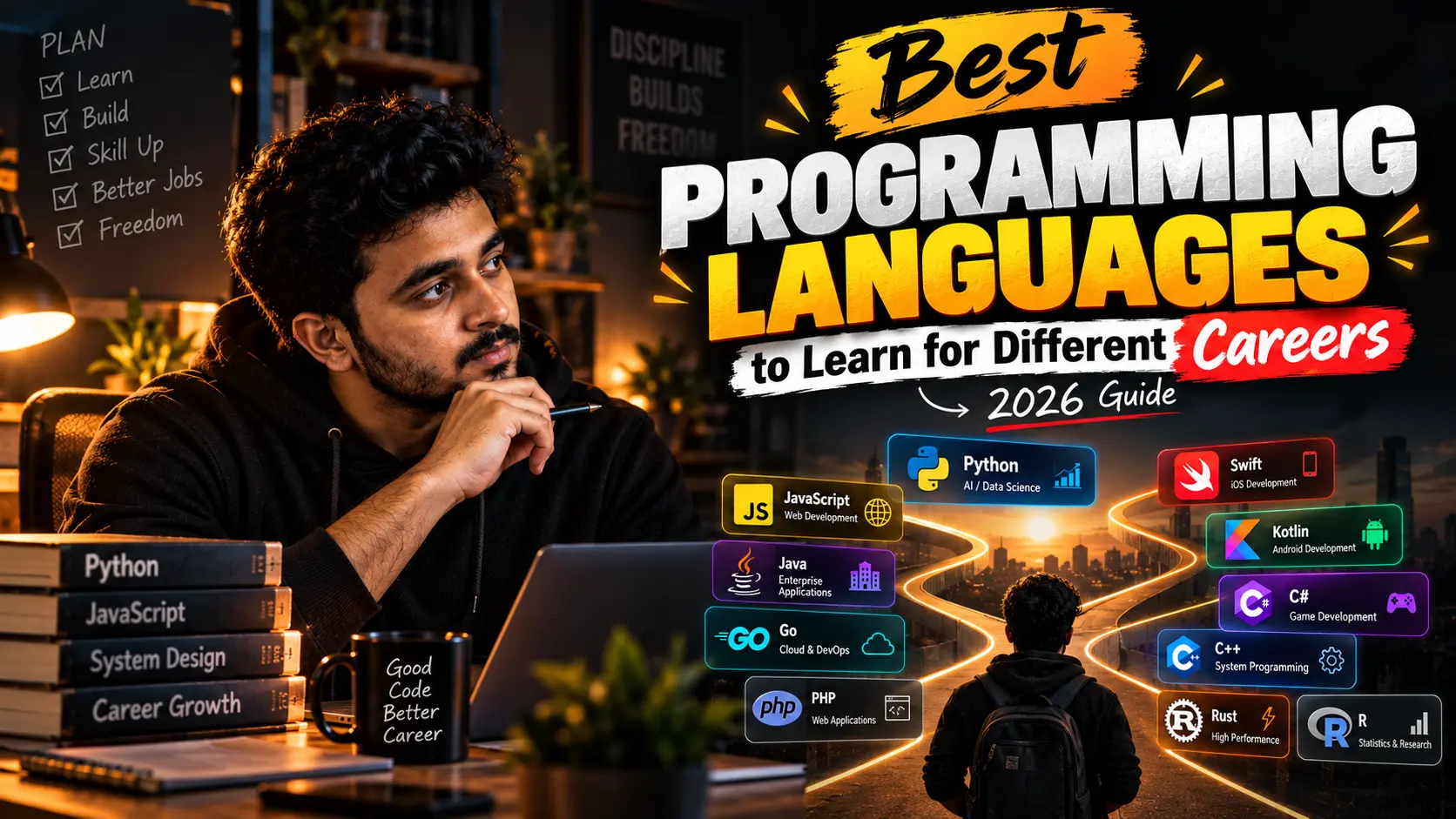
- 1There is no single best programming language, only a best language for a goal. Pick the career first (web, AI, Android, iOS, games, cloud), then the language that most directly serves it.
- 2If you have no goal yet, start with Python or JavaScript. Python leads the TIOBE index at 17.76% (September 2026), while JavaScript was the most used language in Stack Overflow's 2025 survey at about 66%.
- 3Popularity rankings measure different things. TIOBE counts search activity, Stack Overflow counts what surveyed developers use, and neither counts job openings in your city. Check real job listings before you commit.
- 4The popular 'languages by career' infographic leaves out SQL, TypeScript and C, three languages that show up constantly in real work. Learn SQL alongside almost any first language.
- 5Hard languages (C++, Rust) pay off for specific careers, but they are poor first languages for most beginners. Finish one project in an easier language first.
Best Programming Languages to Learn for Different Careers (2026 Guide)
Published: October 11, 2026 · Last updated: October 11, 2026 · 14 min read · By Veeresh Bashetti · Sources linked below
💡 Quick answer, if you're in a hurry: Pick the career first, then the language. Web: JavaScript. Data, AI and automation: Python. Android: Kotlin. iPhone apps: Swift. Games: C# (Unity) or C++ (Unreal). Cloud and DevOps: Go, plus Python and shell scripting. Enterprise: Java or C#. No goal yet? Start with Python or JavaScript, add SQL, and finish one real project before you learn a second language.
Table of Contents
- Why Choosing a Language Feels Harder Than It Is
- The 11 Languages at a Glance
- Phase 1 Data Web and Enterprise
- Phase 2 Performance and Platforms
- Phase 3 Specialist Languages
- What the Infographic Leaves Out
- Popularity Is Not the Same as Jobs
- Quick Career Guide Expanded
- What to Learn First My Suggested Order
- Common Mistakes When Choosing a Language
- Free Videos to Go Deeper
- Copyable Language Checklist
- Final Word My Honest Take
- Sources and Further Reading
- More Useful Resources
Why Choosing a Language Feels Harder Than It Is
Every beginner asks the same question: which programming language should I learn? And every answer online is a different language, usually from someone who loves it. The advice conflicts because people are answering three different questions.
Question 1: Which language is most popular? That has a measurable answer, but it depends on what you measure.
Question 2: Which language is easiest to start with? That depends on how you learn and what you want to build.
Question 3: Which language fits the career I want? This is the question that actually matters, and it is the one most lists skip.
The 11-language structure in this guide follows a popular infographic titled "Best Programming Languages to Learn for Different Careers". I could not find a creator credit on it, so I cannot name one. I like it because it matches languages to careers instead of ranking them. The explanations, code, data and corrections here are my own, checked against TIOBE, the Stack Overflow Developer Survey, Google's Android documentation and W3Techs. Where I add nuance or disagree with the infographic, I say so.
One honest note about my own experience: I build mostly with Python, Django and React, so I know Python and JavaScript hands-on. For the other languages I relied on official documentation and survey data, and I point out where that matters.
If you are still working out the basics of web development, start with my frontend developer roadmap for 2026. If you are already coding and wondering how much computer science theory you need, read do frontend developers need DSA.
The 11 Languages at a Glance
Two numbers are useful side by side. TIOBE estimates popularity from search activity. The Stack Overflow Developer Survey 2025 reports what surveyed developers say they used in the past year. They disagree in interesting ways, which I explain later.
| Language | Best known for | TIOBE rank (Sep 2026) | Stack Overflow 2025 usage |
|---|---|---|---|
| Python | Data, AI and machine learning, automation, backend | 1 (17.76%) | about 57.9% |
| JavaScript | Websites, frontend, full stack, browser tools | 6 (2.76%) | about 66% |
| Java | Enterprise software, banking, backend, Android (legacy) | 4 (7.54%) | about 29.4% |
| C++ | Games, systems, embedded, graphics engines | 3 (8.67%) | about 23.5% |
| C# | Unity games, Windows software, .NET backend | 5 (4.22%) | about 27.8% |
| Swift | iOS, macOS and other Apple platforms | outside top 10 | about 5.4% |
| Go | Cloud, DevOps, microservices | outside top 10 | about 16.4% |
| Rust | Systems, performance, memory safety | 10 (1.34%) | about 14.8% |
| Kotlin | Modern Android apps, backend services | outside top 10 | about 10.8% |
| PHP | Web backends, WordPress, e-commerce | outside top 10 | about 18.9% |
| R | Statistics, research, data visualization | 9 (1.69%) | about 4.9% |
Usage percentages come from the Stack Overflow Developer Survey 2025 (via Statista's chart of the results), and respondents are self-selected, so treat them as a guide to the community, not the whole industry.
Phase 1 Data Web and Enterprise
Language 1: Python
Best for: data science, AI and machine learning, automation, backend development, scripting, research.
Python is the default answer for data and AI work because its syntax is readable and its ecosystem of libraries for data, machine learning and automation is huge. It leads the TIOBE index at 17.76% in September 2026, and about 57.9% of respondents in Stack Overflow's 2025 survey used it, up roughly seven percentage points from the year before.
A nuance the infographic cannot show: Python's TIOBE rating has been slipping through 2026, from 20.97% in April to 17.76% in September, even though it still leads by a wide margin. A shrinking share is not the same as a shrinking job market, but it is a reminder that rankings move.
from collections import Counter

words = "to be or not to be".split()
print(Counter(words).most_common(2))  # [('to', 2), ('be', 2)]
The infographic also lists cybersecurity under Python. That is fair for scripting and tooling, but do not expect Python alone to make you a security engineer. Python is slower than compiled languages for CPU-heavy work, which is why performance-critical parts of data libraries are usually written in lower-level languages.
🛠 Proof of skill: You know enough Python for a first job-ready step when you can write a script that reads a CSV file, summarises one column and prints the result, and you can explain every line.
Language 2: JavaScript
Best for: frontend development, full stack development (with Node.js), web apps, browser extensions, interactive websites, real-time apps.
JavaScript is the language browsers run natively, which makes it unavoidable for frontend work. It was the most used language in Stack Overflow's 2025 survey at about 66%, yet it only ranks sixth on TIOBE at 2.76%. That gap is a measurement difference, not a contradiction, and I explain it in the popularity section below.
const button = document.querySelector("#save");
button.addEventListener("click", () => {
  button.textContent = "Saved!";
});
Two practical points. First, the infographic lists "Mobile Apps" under JavaScript. That is true through frameworks built on JavaScript, but those are a separate skill on top of the language. Second, most professional web teams also use TypeScript, which adds types to JavaScript. I cover it in the "What the Infographic Leaves Out" section.
If you choose this path, my guide to React state is a good next read once you are comfortable with the basics.
Language 3: Java
Best for: enterprise software, banking systems, backend services, cloud applications, big data tools, API development, Android (legacy and existing apps).
Java sits at number four on TIOBE with 7.54% in September 2026. Its rating has been falling slightly: in August it was 8.25%, only 0.37 points behind C++, and by September the gap had widened to 1.13 points. It is still a major language for large organisations that value stability and long-lived systems.
import java.util.List;

public class Main {
    public static void main(String[] args) {
        List<String> names = List.of("Asha", "Ravi", "Meera");
        names.stream()
             .filter(n -> n.length() > 4)
             .forEach(System.out::println); // prints Meera
    }
}
The infographic puts Android first under Java. That is outdated advice for new projects: Google has said Android development is Kotlin-first since 2019, and its documentation says Android apps containing Kotlin code are 20 percent less likely to crash. Java is still supported and widely used in existing Android apps, so learn Java for enterprise and backend roles, and Kotlin for new Android work.

Phase 2 Performance and Platforms
Language 4: C++
Best for: game engines, competitive programming, system programming, operating systems, embedded systems, robotics, high-performance apps, graphics engines.
C++ is number three on TIOBE at 8.67% and was used by about 23.5% of Stack Overflow 2025 respondents. It gives you direct control over memory and performance, which is exactly why it appears in game engines, embedded devices and robotics.
#include <iostream>
#include <vector>

int main() {
    std::vector<int> scores{72, 88, 95};
    int total = 0;
    for (int s : scores) total += s;
    std::cout << total << "\n"; // 255
}
The honest trade-off is difficulty. You manage more details yourself (pointers, memory, build tools), so progress feels slower than in Python or JavaScript. C++ is an excellent choice if you already know you want games, embedded or systems work. It is a hard first language if you simply want to build something quickly.

Language 5: C#
Best for: Unity game development, Windows and desktop applications, enterprise apps, backend APIs, cloud computing, AR and VR projects.
C# is number five on TIOBE at 4.22% and was used by about 27.8% of Stack Overflow 2025 respondents. Its biggest draw for beginners is Unity, the game engine whose scripts are written in C#, which makes it a friendlier path into games than C++.
using UnityEngine;

public class Mover : MonoBehaviour
{
    void Update()
    {
        transform.Translate(Vector3.forward * Time.deltaTime);
    }
}
A fair comparison: if your goal is games, C# with Unity gets you building sooner, while C++ with Unreal Engine is the route for developers who want maximum control and are comfortable with a steeper climb.
Language 6: Swift
Best for: iOS apps, macOS apps, other Apple platforms (watchOS, tvOS, visionOS), wearable apps, App Store projects.
Swift is Apple's language for building apps across its platforms, and it is the clear choice if you want to publish iPhone apps. It is used by about 5.4% of Stack Overflow 2025 respondents, which reflects a focused platform rather than a broad language.
import SwiftUI

struct GreetingView: View {
    var body: some View {
        Text("Hello, iOS")
    }
}
Two corrections to the infographic. First, bullets such as "Secure Applications" and "AI on Apple Devices" are not separate careers, they are things an Apple platform developer may work on. The real job is Apple platform app developer. Second, you can learn the Swift language on Linux or in a browser, but building and shipping iOS apps requires Xcode, which runs only on macOS, so plan for access to a Mac.
⚠️ Heads up: Platform-specific languages tie your skills to one ecosystem. That is fine if you love that ecosystem, but it makes Swift a narrower first choice than Python or JavaScript.
Phase 3 Specialist Languages
Language 7: Go
Best for: cloud and DevOps tooling, microservices, high-performance backends, distributed systems.
Go is used by about 16.4% of Stack Overflow 2025 respondents, and it powers well-known infrastructure tools: Docker and Kubernetes are both written in Go. It is deliberately small and simple, which makes it one of the easier compiled languages to pick up.
package main

import "fmt"

func main() {
    done := make(chan bool)
    go func() {
        fmt.Println("working in a goroutine")
        done <- true
    }()
    <-done
}
The infographic's quick guide says "Cloud and DevOps: Go", but real DevOps work leans heavily on shell scripting too: Bash and shell were used by about 48.7% of Stack Overflow 2025 respondents. You often do not need Go to start in DevOps. You need Linux, the command line and some scripting first, and Go becomes valuable when you write tooling.
Language 8: Rust
Best for: systems programming, performance-critical software, memory safety, concurrent programming.
Rust is the most admired language in Stack Overflow's 2025 survey, at 72%, but only about 14.8% of respondents actually used it. On TIOBE it entered the top 10 for the first time in July 2026 and sits at number 10 with 1.34% in September. That is a strong rise, but it is still a small share.
fn main() {
    let name = String::from("Rust");
    let moved = name; // ownership moves to `moved`
    // println!("{name}"); // compile error: value was moved
    println!("{moved}");
}
Rust's ownership rules are the reason it prevents whole classes of memory bugs, and they are also the reason beginners struggle. TIOBE's CEO said in April 2026 that Rust's steep learning curve is a factor limiting wider adoption. If you are curious about systems work or security-focused software, Rust is a rewarding second or third language. As a first language, it is a tough start.
Language 9: Kotlin
Best for: modern Android apps, cross-platform development, backend services.
Kotlin is used by about 10.8% of Stack Overflow 2025 respondents, and it is the language Google steers new Android development toward. At Google I/O 2019 the company announced Android development would be Kotlin-first, and it says it has stood by that commitment.
data class User(val name: String, val age: Int)

fun main() {
    val user = User("Asha", 24)
    println(user.copy(age = 25)) // User(name=Asha, age=25)
}
If your goal is Android, Kotlin is the more direct path than Java. Knowing some Java still helps, because many existing Android codebases and libraries use it.
Language 10: PHP
Best for: web backend development, CMS development, e-commerce platforms.
PHP is used by 70.8% of all websites whose server-side language W3Techs can detect (July 2026), and WordPress, which is built on PHP, runs about 40.7% of all websites (September 2026). About 18.9% of Stack Overflow 2025 respondents used it. If you want to work on WordPress sites, themes, plugins or online stores, PHP is directly relevant, even though it rarely tops "exciting language" lists.
Language 11: R
Best for: statistics, data analytics, research, data visualization.
R ranks ninth on TIOBE at 1.69% in September 2026, and about 4.9% of Stack Overflow 2025 respondents used it. It shines in academic and statistical work. Python covers much of the same ground for general data jobs, so choose R if your field (statistics, biology, social science research) already uses it heavily.
What the Infographic Leaves Out
A languages-by-career chart is a useful starting point, but three important technologies are missing from the main list, and each one shows up constantly in real work.
| Technology | Why it matters | Evidence |
|---|---|---|
| SQL | Almost every application stores data in a database | About 58.6% of Stack Overflow 2025 respondents; TIOBE number 8 at 2.16% |
| TypeScript | Adds types to JavaScript and is common on professional web teams | About 43.6% on Stack Overflow 2025; reported as GitHub's most-used language by contributors since August 2025 |
| C | Underlies operating systems, embedded devices and much other software | TIOBE number 2 at 10.28% in September 2026 |
| Bash and shell | Daily tool for DevOps, servers and automation | About 48.7% on Stack Overflow 2025 |
HTML and CSS also rank high in surveys (about 61.9%), but they are markup and styling languages, not programming languages. You need them for any web career, but they do not replace learning a programming language.
💡 Tip: Treat SQL as a companion to your first language, not a separate project. Whether you pick Python, JavaScript or Java, learning basic SQL early makes you useful on real applications much sooner.
Popularity Is Not the Same as Jobs
The phrase "most popular language" means nothing until you say which ranking you mean. The three most-cited sources measure different things:
| Source | What it measures | What it tells you |
|---|---|---|
| TIOBE Index | Search activity related to skilled engineers, courses and third-party vendors | Where attention and learning interest are |
| Stack Overflow Developer Survey | What self-selected survey respondents say they used | What the developer community works with |
| GitHub Octoverse | Contributor activity on GitHub | What is being built in open source |
That is why JavaScript is number one in the Stack Overflow survey and sixth on TIOBE: JavaScript developers rarely search for "JavaScript programming" the way learners search for other languages. And it is why TypeScript can top GitHub's contributor numbers while sitting far lower on search-based rankings.
⚠️ Heads up: None of these rankings measure job openings in your city. Before you commit months to a language, search job boards for the exact role you want, in the place you want to work, and see which languages appear in the listings.
Quick Career Guide Expanded
The infographic's quick career guide is a good summary. Here it is with my added context.
| Career goal | Infographic's pick | My note |
|---|---|---|
| AI and machine learning | Python | Correct. Add SQL and basic statistics. |
| Web development | JavaScript | Correct. Add HTML, CSS, then TypeScript. |
| Android development | Kotlin / Java | Kotlin first for new apps, per Google. Java helps with older codebases. |
| iOS development | Swift | Correct. You will need a Mac for Xcode. |
| Game development | C++ / C# | C# with Unity is the gentler start. C++ suits engine-level work. |
| Cloud and DevOps | Go | Start with Linux and shell scripting. Python is common too. Go helps when you write tooling. |
| Cybersecurity | Python / Rust | Python for scripting and tooling. Rust for memory-safe software. Understanding C and C++ helps you grasp low-level vulnerabilities. |
| Enterprise applications | Java / C# | Correct. Add SQL. |
| System programming | C++ / Rust | Add C. Expect a steeper learning curve. |
| Data analytics and statistics | R (other list) | R or Python, whichever your field uses. Add SQL. |
If you are curious how languages connect to the web services you will build, my guide to the types of APIs and their use cases is a practical next step. If AI careers are your target, read GenAI developer career in 2026: hype vs reality and what hiring data shows about AI jobs before choosing.
What to Learn First My Suggested Order
The infographic ends with the line that the best language is the one that helps you solve problems and build a career. I agree, and here is how I would turn that into a plan.
| Stage | What to do | Why this order |
|---|---|---|
| 1 | Choose a career goal and pick one matching language (default: Python or JavaScript) | A goal makes the choice concrete and keeps you motivated |
| 2 | Learn fundamentals and build one finished project | Finishing teaches more than starting five tutorials |
| 3 | Add SQL and basic Git | Used in almost every real project |
| 4 | Add a second language from a different family (for example Python then JavaScript, or JavaScript then TypeScript) | Concepts transfer, and you see what is language-specific |
| 5 | Specialise (Kotlin, Swift, Go, Rust, C++) only if your target role needs it | Hard or narrow languages pay off when the goal is clear |
This is a suggested priority, not a universal rule. If you are applying to a specific company, learn the language in its job listings first.
Common Mistakes When Choosing a Language
- Language hopping. Switching languages every few weeks because a new one looks exciting. Finish one project first. My story of why my first project failed quietly is a lesson in exactly this.
- Choosing by hype or salary screenshots. A language that looks well paid in one chart may have few openings where you live.
- Treating a popularity index as hiring data. TIOBE and Stack Overflow tell you about attention and usage, not vacancies.
- Starting with the hardest language to seem serious. Beginning with C++ or Rust is fine if your goal demands it, but many learners quit before building anything.
- Skipping SQL and Git. They are small to learn and large in everyday value.
- Chasing setup upgrades instead of practice. Better gear will not teach you a language. See the developer setup trap.
- Letting AI do all the typing. AI tools are useful, but you still need to read and verify code. How I use AI every day as a developer shows a workflow that keeps you in control.
Free Videos to Go Deeper
You do not need to pay to start. Watch for the concepts and always check the publication date, because syntax habits and tooling change.
- Learn JavaScript Full Course for Beginners (freeCodeCamp): about 3.5 hours, published December 2018. Good for fundamentals.
- Learn Java Programming, version 17 (freeCodeCamp): about 4 hours, published September 2022.
- C++ Tutorial for Beginners Full Course, Mike Dane (freeCodeCamp): about 4 hours, an older course best used for concepts.
- Learn Python Full Course for Beginners, Mike Dane (freeCodeCamp): just over 4 hours, an older but popular introduction to core Python concepts.
- Kotlin-first Android development (Android Developers): Google's own explanation of why Android is Kotlin-first.
Prefer free tools while you learn? See my list of 9 truly free AI tools for developers.
Copyable Language Checklist
Copy this into your notes or paste it into a study tracker.
Choose
- I have written down the one career goal I am aiming at
- I have matched it to one first language and can say why
- I searched real job listings for that role and checked which languages appear
Learn
- I finished the fundamentals (variables, conditions, loops, functions, data structures)
- I built and finished one small project in this language
- I learned basic SQL and basic Git
Grow
- I can explain the difference between TIOBE, Stack Overflow and GitHub rankings
- I picked a second language only after finishing a project in the first
- I know which specialist language (Kotlin, Swift, Go, Rust, C++) my target role actually requires, if any
Final Word My Honest Take
The honest answer to "which language should I learn" is that it depends on where you want to go, and the goal matters more than the language. Python and JavaScript are the safest starting points because they are large, well documented and useful across many careers. Kotlin, Swift, Go, Rust and C++ are excellent when your goal clearly points at them.
If you remember one thing, make it this: a finished project in an average-fit language beats five abandoned tutorials in the perfect one. Concepts like variables, functions, data structures and debugging transfer from one language to the next, and the second language is always faster than the first.
Pick one goal today. Match it to one language from this guide. Then open a blank file and build the smallest useful thing you can finish this week.
Sources and Further Reading
Technical claims and figures in this article were checked against the following sources in October 2026:
- TIOBE Programming Community Index: how the index measures popularity (search activity), and that it does not rank the "best" language
- TechRepublic: TIOBE Index September 2026: Python 17.76%, C 10.28%, C++ 8.67%, Java 7.54%, C# 4.22%, JavaScript 2.76%, SQL 2.16%, R 1.69%, Rust 1.34%
- TechRepublic: TIOBE Index August 2026: Python 18.53%, C++ 8.62%, Java 8.25%
- IT之家: TIOBE April 2026 (in Chinese): Python 20.97% in April 2026 and the TIOBE CEO's comments on Rust's learning curve
- Stack Overflow Developer Survey 2025: Technology: Rust as the most admired language at 72%
- Statista: most used programming languages among developers 2025: usage percentages from the Stack Overflow 2025 survey (May 29 to June 23, 2025)
- Android Developers: Kotlin-first: Kotlin-first announcement at Google I/O 2019 and Google's stability claim
- W3Techs: PHP usage: PHP on 70.8% of websites with a known server-side language (July 2026)
- W3Techs: WordPress usage: WordPress on about 40.7% of all websites (September 2026)
- freeCodeCamp: Learn Java Programming (version 17): course details for the Java video
- Quash: programming language popularity statistics: secondary summary of GitHub's Octoverse 2025 finding that TypeScript became the most-used language on GitHub in August 2025 (check GitHub's primary report for the latest figures)
Language rankings and survey numbers change monthly or yearly, so confirm current figures before making a career decision. Code examples are simplified for teaching. Job demand varies by country, city and company, so check live job listings for the role you want.
This article is maintained and updated as the language landscape changes. If you spot outdated information, please use the Contact page to flag it.
About the Author
Veeresh Bashetti is a full-stack developer who builds Django and React applications and writes practical, project-tested guides for developers and students, with a focus on separating genuine industry trends from marketing hype. Read more on the About page.
More Useful Resources
- Frontend Developer Roadmap 2026: 12 Steps, in Order
- Do Frontend Developers Need DSA? 12 Concepts to Learn (2026)
- Types of APIs and Their Use Cases (2026 Guide)
- GenAI Developer Career in 2026: Hype vs Reality for Students
- 10 AI Prompts for Job Seekers in 2026: Resume to Interview
- 5 Common Django Mistakes Beginners Make (and Fixes)
- More Tech Articles
Did you find this helpful?
FAQ