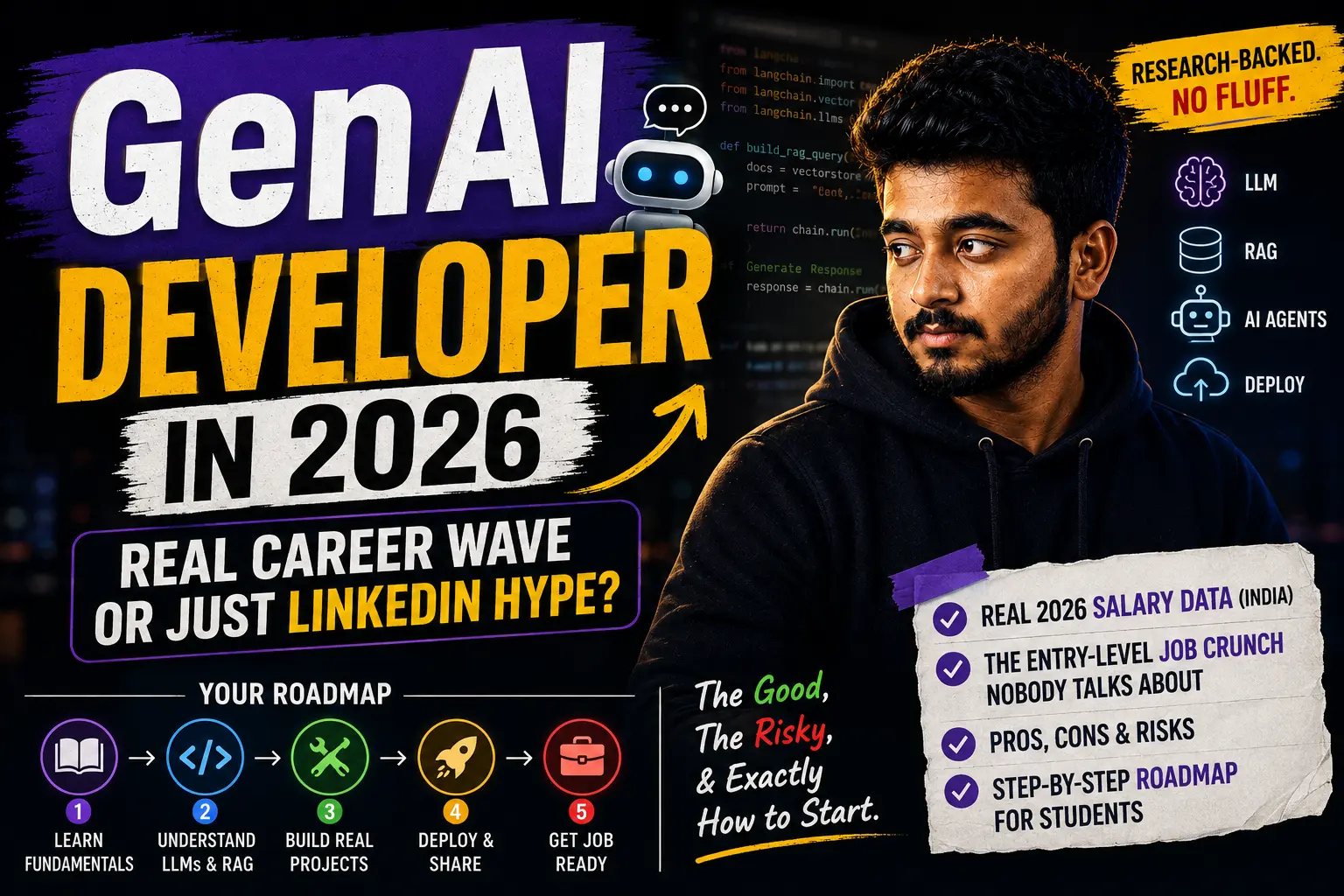
- 1GenAI Developer is a real, distinct job title now — it means building applications on top of existing LLMs (RAG, agents, APIs), not training AI models from scratch. That confusion alone causes half the hype.
- 2The salary numbers are real but selective: entry-level GenAI roles in India realistically start around ₹6–12 LPA for genuine freshers with projects, while the ₹20–25 LPA+ figures usually belong to engineers with 2–5+ years of experience or a specialised skill like production RAG or fine-tuning.
- 3There is a real, well-documented cost to this trend: entry-level coding job postings have dropped sharply since 2022 because AI now handles a lot of the repetitive work that used to train juniors. This is the part most 'become a GenAI developer' ads leave out.
- 4It genuinely can be a strong path for students — but only if you build real projects (a working RAG app, an agent, a deployed API), not just watch tutorials and collect certificates.
- 5The honest verdict: learn GenAI as a layer on top of solid programming fundamentals, not as a replacement for them. Students who skip fundamentals and jump straight to 'prompting' are the ones most exposed if the hype cools down.
GenAI Developer in 2026: Real Career Wave or Just LinkedIn Hype?
Published: August 7, 2026 · Last updated: August 9, 2026 · 14 min read · By Veeresh Bashetti · Reviewed against 2026 hiring data
Quick honest answer, if you're in a hurry: GenAI Developer is a real job, the demand is real, and the salaries at the top end are real. But a lot of what's flooding your Instagram and LinkedIn feed right now — "become a GenAI developer in 30 days and earn 20 LPA" — is marketing, not the median outcome. This guide separates the two, using actual 2026 hiring data with direct source links, and gives you a simple, honest roadmap if you decide it's worth pursuing.
Table of Contents
- Why Your Feed Is Suddenly Full of "GenAI Developer" Ads
- What a "GenAI Developer" Actually Does
- Is This Genuinely a Good Career, or Just Hype?
- The Uncomfortable Truth About Entry-Level Jobs
- Pros and Cons for Students
- GenAI Developer vs ML Engineer vs Prompt Engineer
- The Beginner-to-Pro Roadmap
- Free Resources Worth Your Time
- Downloadable Checklist
- FAQs
- Final Word
- Sources & Further Reading
- More Useful Resources
Why Your Feed Is Suddenly Full of "GenAI Developer" Ads
If you're a student in India right now, you can't scroll for two minutes without seeing an ad for a "Generative AI course" promising a six-figure salary. There's a simple reason for that timing, and it's not a conspiracy — it's basic economics.
According to the foundit (formerly Monster APAC) Insights Tracker report, generative AI and large language model (LLM) skills saw close to a 60% year-on-year jump in demand across Indian job postings in 2025, with total AI hiring in India projected to grow 32% in 2026 to nearly 380,000 positions, up from roughly 290,000 AI-linked roles posted in 2025. That kind of sudden demand spike is exactly the environment where ed-tech marketing thrives — real growth, dressed up with unrealistic promises to sell courses faster than the market can actually absorb people.
So the honest starting point is: the underlying trend is real. The way it's being sold to you is often exaggerated. Let's separate the two properly.
What a "GenAI Developer" Actually Does (In Simple Words)
Here's the confusion at the heart of most of this hype: people assume a GenAI Developer builds AI models, the way a research lab builds something like GPT or Gemini. That's not the job. Almost nobody starting out does that — it needs huge compute, research-level math, and years of specialisation.
A GenAI Developer, in the way companies are actually hiring for it in 2026, is someone who builds applications on top of an already-existing AI model — using it as a smart component inside a normal piece of software. Think of it like this:
- A web developer builds the website around a database.
- A GenAI developer builds the application around an AI model — usually accessed through an API from OpenAI, Anthropic, or Google.
In practice, the day-to-day work looks like:
- Prompt engineering — writing instructions that reliably get useful, consistent output from a model
- RAG (Retrieval-Augmented Generation) — connecting the AI to your own company's documents or data, so it can answer questions about things it was never trained on
- AI agents — building systems where the AI can use tools, search the web, run code, or call other APIs to complete a task on its own
- Deployment — turning all of this into a working product with an API, proper error handling, and cost/latency monitoring, not just a Jupyter notebook demo
This distinction matters more than almost anything else in this guide: a GenAI Developer is closer to a software engineer who specialises in AI tools, not an AI researcher. That single misunderstanding is responsible for most of the confusion — and most of the false promises — in GenAI course marketing today.
A simple mental diagram of where a GenAI Developer sits:
[ Your Product / App ]
        |
        v
[ GenAI Developer's Code ]  --->  Prompt engineering, RAG, agents, APIs
        |
        v
[ Pre-trained LLM (via API) ]   e.g. OpenAI, Anthropic, Google
        |
        v
[ Model Training / Research ]   <-- This is the ML Engineer / Researcher's job, NOT the GenAI Developer's
Is This Genuinely a Good Career for Students, or Just Hype? — The Honest Answer
Both things are true at once, and that's uncomfortable, but it's the accurate picture.
The part that is real
Multiple independent hiring reports for 2026 point in the same direction:
- India is projected to need roughly 1 million additional AI-skilled professionals by 2026, according to Nasscom's State of Data Science & AI Skills in India report, with a persistent shortage of engineers who can actually ship production-grade GenAI systems. A related Nasscom-Deloitte report projects India's AI talent pool growing from ~600,000–650,000 to over 1.25 million between 2022–27, even as the market grows faster still.
- AI/ML recruitment across Indian job postings has grown around 32% year-on-year for 2026 per the foundit Insights Tracker report, well ahead of general IT hiring.
- Senior, specialised roles — particularly production RAG design, LLM engineering, and AI architecture — command genuinely premium salaries in industry reporting, with senior specialists in some markets earning ₹25–60 LPA, and Global Capability Centres (GCCs) paying at the top of that range for scarce, production-tested skills.
- IT-software (37% share), BFSI (15.8% share, growing 41% YoY), and healthcare (38% YoY growth) are the sectors leading this hiring wave per the same foundit data, which means the demand is spread across more than just pure tech companies.
The part that gets left out of the marketing
- Most of the eye-catching salary numbers (₹25 LPA+) belong to people with real experience and a specialised skill — production RAG systems, fine-tuning, or LLMOps — not to someone finishing a 6-week course with zero prior coding background.
- Entry-level GenAI roles in India realistically start closer to ₹6–12 LPA for genuine freshers, and only when they have real, working projects to show, not just certificates.
- There's an oversupply forming at the tutorial level: a lot of applicants have built small demo chatbots but have never shipped anything that handles real users, real errors, or real cost limits — and recruiters can tell the difference quickly in an interview.
- This is happening at the same time entry-level software jobs overall are shrinking, which is the part almost no course advertisement mentions, and it deserves its own honest section.
The Uncomfortable Truth: AI Is Also Shrinking Entry-Level Coding Jobs
This is the part of the conversation most "learn GenAI, get rich" content conveniently skips, and it matters a lot if you're a student trying to plan the next few years.
The data here is fairly consistent across multiple 2026 hiring reports:
- Entry-level and new-grad hiring at major US tech companies has fallen sharply since 2019 — SignalFire's State of Talent Report 2026 puts new-grad/entry-level hiring down roughly 65% at large tech companies and ~76% at early-stage startups compared to 2019, with total hiring at major tech firms running about 25% below the 2019 baseline. Separately, the Stanford HAI 2026 AI Index reports employment for developers aged 22–25 down roughly 20% since 2022, while employment for developers aged 35–49 rose 9% over the same period — largely because AI coding tools now handle a lot of the repetitive, low-risk tasks (boilerplate code, simple bug fixes, basic test scaffolding) that used to be a junior developer's on-ramp into a company.
- At the same time, overall engineering employment has held up far better than other tech functions — SignalFire's 2026 report found engineering hiring at large tech companies down just 11% from 2019 versus 25% for total hiring, and engineers now make up 55% of all new hires (up from 46% in 2019). Senior engineers — the ones reviewing AI-generated code, making architectural decisions, and taking responsibility for what ships — are more in demand than ever.
- It's not one-directional either: IBM announced in February 2026 that it will triple entry-level hiring in the US specifically because, in the words of CHRO Nickle LaMoreaux, cutting junior pipelines today risks leaving "nobody left to eventually become the senior engineers a company needs" three to five years out. The roles themselves are being redesigned — junior developers now spend less time on routine coding and more time working directly with customers and overseeing AI output, rather than being eliminated outright.
What this actually means for you as a student: the danger isn't that "AI will take all the jobs." The real, documented risk is narrower — the traditional easy on-ramp into tech (get hired as a junior, learn on the job doing simple tasks) is getting harder to find, because AI now does a lot of that simple work. The response to that isn't panic. It's making sure you don't rely on being "the person who can write basic code" as your only skill — because that specific skill is exactly what's being automated first.
GenAI Developer: Pros and Cons for Students (No Sugar-Coating)
| Pros | Cons | |
|---|---|---|
| Demand | Real, fast-growing demand across IT, BFSI, healthcare, retail — not limited to "AI companies" | Demand is concentrated at mid-to-senior level; entry-level GenAI-only roles are still relatively few |
| Salary | Meaningful premium over average software roles once you have real project experience | Headline salaries (₹20L+) mostly apply to experienced or specialised engineers, not freshers |
| Learning curve | You don't need deep ML math to start — Python + APIs is enough to begin building | The tooling (LangChain, LangGraph, vector DBs) changes fast; you have to keep relearning |
| Job security | Skills transfer well — RAG, agents, and API integration are useful across almost any software role | If you only learn "prompting" with no core programming, you're easily replaced by the same AI you're using |
| Market state in 2026 | Genuine, well-documented skills shortage in production-grade GenAI engineering | A parallel oversupply of shallow, tutorial-only candidates makes interviews more competitive than expected |
| Long-term outlook | Treated as one of the most durable, growing specialisations in software right now | It's still a young field — best practices, tools, and even job titles are actively shifting year to year |
The honest takeaway from this table: the risk isn't choosing GenAI. The risk is choosing GenAI instead of fundamentals, rather than on top of them.
GenAI Developer vs ML Engineer vs Prompt Engineer — Stop Confusing These
This mix-up causes a lot of wasted time for students picking a learning path, so let's make it simple.
- ML Engineer — trains and builds machine learning models from raw data. Needs stronger math, statistics, and model-training experience. Closer to a research-adjacent role.
- GenAI Developer / AI Engineer (applied) — uses already-trained models (GPT, Claude, Gemini, open models) as a component inside an application. Focuses on prompting, RAG, agents, APIs, and system integration. Closer to a software engineering role with an AI specialisation.
- Prompt Engineer — a narrower, mostly historical title focused only on writing effective prompts. Industry data for 2026 shows this title steadily merging into the broader GenAI Developer / Applied AI Engineer role, because "just prompting" alone is rarely a full-time job anymore.
If you're a student choosing where to focus, GenAI Developer / Applied AI Engineer is the more future-proof lane of the three for most people, because it builds directly on programming skills you'll need anyway, rather than depending on one narrow skill.
The Beginner-to-Pro Roadmap (What to Actually Learn, In Order)
This is the part most hype content skips entirely — the actual sequence, not just a buzzword list. Based on how current 2026 roadmaps and bootcamps structure this (and what recruiters are consistently asking for), here's the honest order:
Stage 1 — Foundations (don't skip this, even if it feels slow)
- Python fundamentals: functions, classes, dictionaries, exception handling, virtual environments. You need to be comfortable enough to debug a multi-file project, not just complete exercises.
- REST API basics: how requests, responses, headers, and authentication work. Every GenAI tool you'll touch is built on top of APIs.
- Git and GitHub: because every project you build needs to live somewhere recruiters can actually see it.
Stage 2 — Talking to AI models
- LLM APIs: OpenAI, Anthropic (Claude), and Google Gemini SDKs — learn how to send a request and get a structured response back.
- Prompt engineering: zero-shot, few-shot, and chain-of-thought prompting; how to get consistent, structured output instead of random text.
- Build your first small project: a simple chatbot or a text summariser using just an API call. This is where "I understand it" becomes "I can actually build it."
Stage 3 — Making AI useful with your own data (RAG)
- Embeddings and vector databases: FAISS (free, local), Chroma (simple), or Qdrant/Pinecone (production-grade) — how text gets converted into searchable vectors.
- RAG pipelines: chunking documents, retrieving relevant pieces, and injecting them into a prompt so the AI can answer questions about your data, not just its training data.
- Project: build a "chat with your PDF/document" tool. This single project alone demonstrates a genuinely in-demand, production-relevant skill.
Stage 4 — AI Agents
- Tool-calling and agents: systems where the AI decides which tool to use — web search, a calculator, a database query — instead of just replying with text.
- Frameworks: LangChain for orchestration, LangGraph for more complex, stateful agent workflows.
- Project: an agent that can look something up, do a calculation, and give a final answer — a small but real demonstration of "agentic" thinking.
Stage 5 — Production skills (the part that actually gets you hired)
- Deployment: wrap your project in a FastAPI backend, containerise it with Docker, and deploy it somewhere real (even a free tier works for a portfolio project).
- Evaluation: learn to measure whether your RAG system is actually giving correct, relevant answers — not just whether it "looks fine" in a demo.
- Cost and reliability awareness: understanding token costs, rate limits, and error handling — the difference between a tutorial project and something a company could actually use.
Realistic timeline: if you already know Python and basic web concepts, 60–90 days of focused, project-based learning is a commonly cited, realistic target across current roadmaps. Starting from zero programming background, budget closer to 8–14 months — and that's fine. Fundamentals first, always.
<div style="margin: 2rem 0;">
Free Resources Worth Your Time (No Paid Course Required to Start)
You do not need to spend money to get a genuinely strong foundation. These are free, well-regarded, and map directly onto the roadmap above:
- freeCodeCamp's LangChain and Generative AI courses (YouTube) — full, structured, project-based courses covering everything from basic LLM APIs to RAG and deployment, completely free.
- Hugging Face's free LLM and Agents courses — solid for understanding tokenisation, transformers, and open-source models without needing a paid subscription.
- Official documentation for OpenAI, Anthropic, and LangChain — genuinely well-written, and the fastest way to stay current since this field's tooling changes every few months.
- RAGAS and LangSmith docs — once you've built a basic RAG project, these teach you how to actually measure whether it's good, which is a skill most beginner tutorials skip entirely.
Downloadable 90-Day Checklist
Copy this into a notes app, spreadsheet, or print it — this is the condensed, actionable version of the roadmap above:
Days 1–15 — Foundations
- Comfortable writing multi-file Python scripts with functions and classes
- Understand REST API requests, responses, and authentication
- GitHub account set up with your first repo pushed
Days 16–30 — Talking to AI models
- Made at least 20 API calls to an LLM provider (OpenAI/Anthropic/Gemini)
- Practiced zero-shot, few-shot, and chain-of-thought prompting
- Shipped Project 1: a simple chatbot or summariser
Days 31–55 — RAG
- Understand embeddings and how vector search works
- Built a chunking + retrieval pipeline
- Shipped Project 2: "chat with your PDF" tool
Days 56–75 — Agents
- Understand tool-calling and agent loops
- Built a basic agent with LangChain or LangGraph
- Shipped Project 3: an agent that looks something up and computes an answer
Days 76–90 — Production & job-readiness
- Deployed one project with FastAPI + Docker
- Added basic evaluation/logging to a RAG project
- Portfolio (GitHub + README + live demo link) ready to share with recruiters
Frequently Asked Questions
Is GenAI Developer just a rebranded name for Prompt Engineer?
Partly, yes — but the role has grown well past prompting alone. A GenAI Developer today is expected to build retrieval-augmented generation (RAG) pipelines, connect vector databases, orchestrate AI agents that call tools, and deploy all of it as a working API or product. Prompt engineering is now just one small skill inside a much bigger job, which is why many pure "Prompt Engineer" job titles are merging into broader roles like Applied AI Engineer or GenAI Developer.
Can a fresher really get a GenAI developer job with no prior software experience?
It's difficult but not impossible, and it's harder than the marketing suggests. Recruiters and hiring reports for 2026 consistently say they are not hiring people who only know how to prompt an AI model — they want core programming ability (usually Python), an understanding of APIs, and at least one real, working project, on top of GenAI-specific skills. Think of GenAI skills as an addition to solid software fundamentals, not a shortcut around them.
Is it true that AI is taking away junior developer jobs?
This part is genuinely true and well documented, not just hype in the other direction. Entry-level developer job postings have fallen sharply since 2019–2022 as AI tools started handling routine, repetitive coding tasks that used to be a junior's on-ramp into the industry — SignalFire's 2026 report and the Stanford HAI AI Index both confirm this from different angles. At the same time, some large companies — IBM among them — are increasing junior hiring specifically because they've realised losing that training pipeline creates bigger problems later. The honest picture is "harder, not gone" — the bar for what a fresher is expected to know has simply moved up.
How long does it actually take to become job-ready as a GenAI developer?
For someone who already knows Python and basic web/API concepts, most structured roadmaps and bootcamp data point to roughly 60–90 days of focused, project-based learning to reach a genuinely job-ready level. Starting from zero programming knowledge, a more realistic timeline is 8–14 months, because you first need solid fundamentals before GenAI-specific tools make sense.
Do I need to learn machine learning theory and math to become a GenAI developer?
No, not to get started. Building applications with existing large language models — RAG systems, chatbots, AI agents — mainly requires Python, comfort with REST APIs, and software engineering basics. Deep ML theory and math matter more if you later move toward training or fine-tuning models yourself, which is a different, more research-heavy specialisation.
Final Word: My Honest Take
I write practical tutorials for a living, so I read a lot of this hiring data every month. Here's the plainest way I can put it: GenAI Developer is a real, growing job — but it's not a shortcut, and it's not risk-free. The students who genuinely benefit from this trend are the ones who treat GenAI as a specialisation layered on top of real programming skill. The ones who get hurt are the ones who skip fundamentals, collect a certificate, and expect a ₹20 LPA offer for knowing how to write a good prompt.
If you're a student deciding right now: learn Python properly, build one real RAG project and one real agent project, deploy both somewhere public, and put them on GitHub. That combination — fundamentals plus two working GenAI projects — will put you ahead of most people chasing this trend on hype alone.
Sources & Further Reading
The data referenced in this article draws on 2026 hiring and salary reports and industry commentary, including:
- foundit (Monster APAC) Insights Tracker Report — India AI hiring growth, GenAI/LLM demand jump, sector breakdown (via Careers360)
- Nasscom: State of Data Science & AI Skills in India — India's projected 1 million AI professional shortfall by 2026
- Deloitte-Nasscom: Advancing India's AI Skills report — India's AI talent pool growth 2022–27
- SignalFire State of Talent Report 2026 — entry-level/new-grad hiring decline at major tech companies and startups
- Stanford HAI 2026 AI Index — employment trends for developers aged 22–25 vs 35–49 since 2022
- IBM: The bottom rung returns as AI reshapes entry-level jobs — IBM's 2026 entry-level hiring expansion and reasoning
Salary figures are directional ranges reported across multiple sources as of mid-2026, not guarantees. Always cross-check current numbers before making a career decision, since this market is moving fast..
This article is maintained and periodically updated as new hiring data is published. If you spot outdated information, please use the Contact page to flag it.
About the Author
Veeresh Bashetti is a full-stack developer documenting his learning journey, experiments, tools, and real-world development experience. He publishes tutorials, reviews, productivity workflows, and practical, project-tested guides for developers — with a focus on separating genuine industry trends from marketing hype. Read more on the About page or get in touch via the Contact page.
More Useful Resources
- 9 AI Tools That Are Actually 100% Free for Developers in 2026
- 10 AI Prompts Every Job Seeker Needs in 2026
- 15 Chrome Extensions Every Developer Should Have Installed in 2026
- More Career & Tech Articles
Did you find this helpful?
FAQ