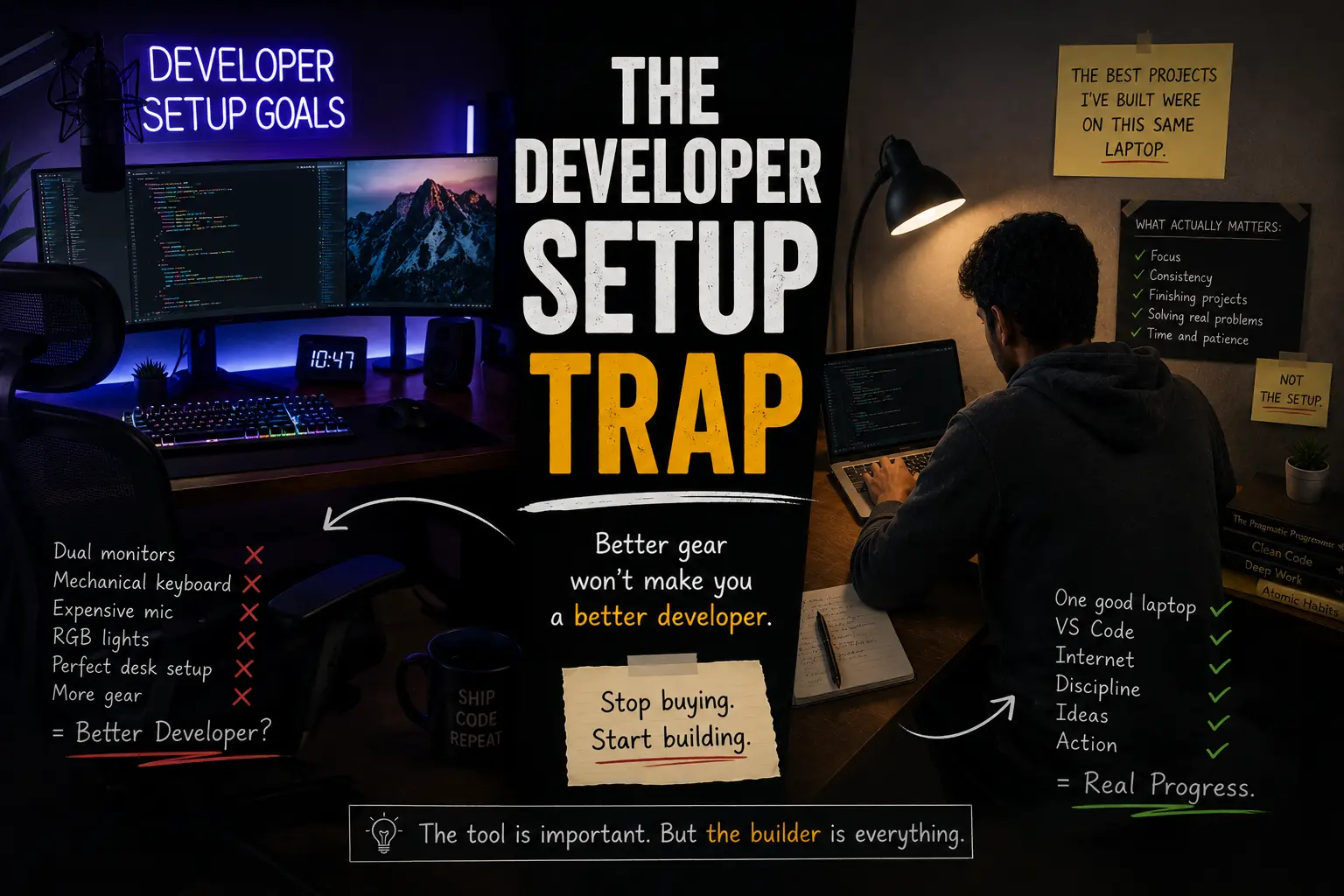
- 1The setup is the reward of a productive career, not the ingredient of one. Every developer with a beautiful desk got it after years of building on ordinary machines.
- 2The real test before any hardware purchase: is my specific, current work actually blocked — not slowed, actually blocked — by a specific hardware limitation right now? If no, keep building.
- 3The one hardware upgrade research consistently supports is a second monitor. Everything else has diminishing returns compared to building better habits.
- 4One genuine distraction-free hour of work produces more than a full afternoon of open-tab, notification-interrupted coding. Your attention is the bottleneck, not your machine.
- 5If you find yourself researching gear during a stretch where you have not shipped anything in over a week, the impulse is avoidance wearing the costume of preparation.
The Developer Setup Trap: Why Better Hardware Won't Make You a Better Developer
I spent Rs 13,000 on a hardware upgrade. The compile times got slightly faster. The projects I had not finished stayed unfinished. That is the whole lesson, really.
It starts the same way for almost everyone.
A YouTube video. A developer's desk tour. Two monitors. A mechanical keyboard with satisfying clicks. A lamp that costs more than your weekly groceries. Their code flows fast, their workspace looks curated, their whole setup radiates the feeling of serious work.
And somewhere in the middle of watching, you stop paying attention to what they're building and start looking at your own desk. Your single monitor. Your basic keyboard. Your laptop that takes a minute to boot VS Code when too many tabs are open.
A quiet thought forms: maybe that's why I'm not as productive.
I know this thought intimately. I acted on it. I spent money I did not have. And nothing changed — except my bank balance.
If you've ever wondered whether a better setup makes you a better developer, or you're pricing out the best budget developer setup in India for 2026, this is the honest version — written by someone who already made the mistake so you don't have to.
What I Actually Did — The Rs 13,000 Mistake
I will be specific, because vague warnings are useless.
In 2024, I was stuck. A side project I had been building for two months was going nowhere. My motivation was low, my builds felt slow, and I had convinced myself — through a very well-constructed internal argument — that my CPU was the bottleneck.
I found a second-hand CPU listing on OLX. The price felt reasonable. I spent Rs 10,000 of scholarship money I had been saving and Rs 3,000 that my mother gave me, no questions asked, because she trusted me.
I upgraded. I benchmarked. And then I opened my project folder. Looked at the code I had not touched in two weeks. And felt exactly the same paralysis I had felt before.
The compile times were slightly faster. The projects I had not finished remained unfinished. The habits I had not built remained absent. The discipline I lacked was not faster hardware.
It never was.
Why the Developer Setup Trap Is So Effective
Developer YouTube, Twitter/X, and Reddit have built an entire aesthetics culture around workspaces. It is genuinely beautiful content. And it works because of a deep psychological pattern: we associate the tools of experts with the expertise itself.
The ultrawide monitor looks like serious work. The ergonomic chair looks like someone who takes their health seriously. The Rs 8,000 mechanical keyboard sounds like a person who cares deeply about their craft.
But the association is visual, not causal.
The setup is the reward of a productive career. Not the ingredient of one.
Every developer you see with a beautiful desk got it after years of building things on ordinary machines. The setup followed the work. It did not produce it.
This Trap Exists in Every Creative Field
Writers go broke buying the perfect notebook before they have written a single paragraph. Musicians spend months comparing DAWs instead of recording the song that is already in their head. Photographers buy new lenses before they have mastered the focal length they already own.
In every creative and technical field, there is a seductive belief that gear is the gap between where you are and where you want to be.
It is never the gap.
What separates beginners from experts is not gear. It is hours of deliberate, uncomfortable practice. It is the discipline of finishing things you started. It is the habit of shipping something even when it is not ready. It is the ability to stay in the chair past the point where it stops being fun.
None of these can be purchased.
What Actually Makes You a Better Developer
I have been specific about what does not work. Here is what does — and this is the part most "developer productivity" content in India skips, because gear reviews are easier to write than honest habit advice.
Finishing small things, repeatedly. Your ability to ship is a muscle. It develops through use and atrophies through neglect. Every project you finish — no matter how small, no matter how embarrassing — makes it slightly easier to finish the next one. Every abandoned folder weakens it. Build the habit of done.
Constraints, not capability. The best projects I have shipped were built under constraint. Limited time. Limited hardware. Limited scope. Constraints force clarity. Unlimited resources produce scope creep and paralysis.
Deep debugging, not workarounds. Developers who understand their tools deeply are often the ones who had to fight with limited machines. When you cannot throw hardware at a problem, you are forced to understand it. That understanding transfers everywhere.
One focused hour over four scattered ones. One genuine, distraction-free, phone-face-down hour of work produces more than a full afternoon of open-tab, notification-interrupted, half-engaged coding. Your attention is the bottleneck. Not your machine.
When Hardware Does Actually Matter for Developers
I want to be fair, because this is not an anti-hardware post.
There are real cases where hardware is a genuine constraint:
- Training ML models on-device
- Running multiple heavy virtual machines simultaneously
- Professional video editing and rendering
- Large-scale 3D or game development work
- Running 8 or more large codebases with full language servers active
In these specific cases, hardware matters. But notice the precision of these scenarios. They are current, specific, defined bottlenecks — not hypothetical future needs.
The test is simple: Is my specific, current work actually blocked by a specific hardware limitation right now?
Not "would it be faster?" Not "might I need this someday?" Not "would it be nicer?"
Is it blocked. Right now.
If yes, upgrade with precision. Buy the minimum that unblocks the specific thing. If no, keep building.
The Best Budget Developer Setup in India 2026 — What Is Actually Worth Buying
Since you are here and thinking about setup, here are honest recommendations for the best budget developer setup in India — things that do have measurable impact, with real context for when they make sense.
1. A Second Monitor — The One Hardware Upgrade That Research Actually Supports
This is the single hardware upgrade that consistently helps developer productivity in India and everywhere else. Not because it looks impressive, but because context-switching between documentation, terminal, and code editor is genuinely slower on a single screen.
What to look for: 24 to 27 inches, 1080p for side or reference use, IPS panel for better colour and viewing angles.
Best options on Amazon India:
- Acer B227Q D1 21.5" IPS Full HD Monitor — Rs 8,999 · 4.0 stars — solid entry-level IPS, great for a secondary reference screen
- Dell S2421HN 24" Full HD IPS — Rs 11,499 · 4.3 stars — ultra-thin bezels, dual HDMI, excellent colour accuracy for long sessions
When to buy: When you are actively working across multiple windows daily. Not as a reward for future productivity.
2. A Laptop Stand — Highest ROI Under Rs 2,000
If you work on a laptop all day, your screen is at the wrong height. That is not opinion, it is basic ergonomics. Your neck is tilted downward for 6 to 8 hours, and over months, that becomes real back and neck pain.
Pair a laptop stand with any external keyboard and you have a workstation setup that costs under Rs 2,000 and genuinely changes your posture.
Best option on Amazon India:
- Portronics My Buddy K3 Laptop Stand — Rs 499 · 4.2 stars — 6 adjustable height levels, foldable, supports up to 15.6 inch, best value under Rs 1,500
3. A Keyboard — Comfort First, Clout Never
Mechanical keyboards are not a productivity tool. They are an ergonomics tool and, at their worst, a status symbol.
The honest truth: most productivity people attribute to mechanical keyboards is the placebo effect of spending money. But there is a real ergonomics benefit if you type for hours daily and your current keyboard is causing wrist or finger fatigue.
Do not buy: Any keyboard over Rs 5,000 if you are a student or early-career developer. Custom keycaps. Anything that takes longer to research than it would take to finish a small project.
Best option on Amazon India:
- Redragon K630 Dragonborn 60% Wired Keyboard — Rs 1,989 · 4.5 stars — compact 60% layout, great tactile feel, best entry mechanical keyboard for developers
When to buy: If your current keyboard causes discomfort after extended use. Not because a YouTuber's setup looked impressive.
4. Noise-Cancelling Headphones — The Focus Upgrade That Actually Matters
This is the one category I will argue for most strongly. Focus is your actual bottleneck, and ambient noise is a real destroyer of it.
If you live in a shared apartment, a hostel, or a busy household — which most of us in India do — and you are trying to do deep work, noise-cancelling headphones are not a luxury. They are an environment tool.
Best options on Amazon India:
- boAt Rockerz 550 Bluetooth Headphones — Rs 1,999 · 4.1 stars — 20 hours battery, best budget option under Rs 2,000
- Sony WH-CH520 Wireless Bluetooth Headphones — Rs 3,749 · 4.6 stars — 50 hours battery, lightweight, best all-round value for developers
5. A Wireless Mouse — Small but Useful
A good mouse removes the friction of touchpad-only work, especially when you are debugging across files or working with design tools.
Best option on Amazon India:
- Portronics Vader Pro Transparent Wireless Mouse — Rs 659 · 4.5 stars — tri-mode connectivity (Bluetooth, 2.4GHz, and wired), adjustable DPI, rechargeable, genuinely excellent value
What NOT to Buy
- A Rs 40,000 GPU because you "might do ML someday"
- A Rs 20,000 CPU upgrade when you have not shipped a project in three months
- 32GB RAM when you are building web apps and your 8GB handles it fine
- A course subscription to fix motivation that is actually a burnout problem
- A second external SSD because your project folders are "getting cluttered" — they are not; you are procrastinating
If you find yourself researching hardware during a stretch where you have not touched your project in over a week, close the browser tab. That impulse is a signal, not a task.
This video makes the same argument from a different angle — what habits and decisions actually separate the developers who grow from the ones who stay stuck. No hardware required:
The Honest Version Nobody in Developer Content Will Say
Most developers who obsess over setups are avoiding building things.
Not all. But most. And the mechanism is subtle enough that it feels nothing like avoidance. It feels like preparation. Like investment. Like taking your work seriously.
The way to test it is simple: when did you last ship something? When did you last close a loop, even a small one? A project, a feature, a blog post, a script that solved a problem for someone?
If the answer is recent, you are fine. Buy what you need, ignore the rest.
If the answer is "I am still working on it" and that has been the answer for months, then no monitor, no keyboard, no CPU, no course is what you need.
You need to open your editor and build something small enough to finish this week.
That is the real upgrade.
The Setup I Actually Use
I have been building on the same laptop for three years.
It is not beautiful. It does not appear in setup tours. The sticker on the lid is peeling. But VS Code runs, the terminal runs, Git works, and everything I have shipped — every project, every freelance job, every post on this blog — was built on this machine.
The work that mattered did not come from the machine. It came from sitting down, opening the editor, and not stopping until something was done.
That requires nothing I did not already have.
And if I am honest, neither does yours.
Frequently Asked Questions
Does a better setup make you a better developer?
No, in most cases. The setup is the reward of a productive career, not the ingredient of one. What actually improves development skills is finishing small projects repeatedly, debugging deeply instead of finding workarounds, and building focused uninterrupted work habits. Hardware only matters when a specific, current task is genuinely blocked by a specific hardware limitation.
What is the best budget developer setup in India in 2026?
For most developers in India, the highest-ROI setup improvements are: a second monitor (24 inch FHD IPS, around Rs 8,000 to 11,500), a laptop stand (under Rs 1,500), and noise-cancelling headphones for focus (Rs 1,999 to 3,749). These three upgrades cost under Rs 15,000 total and have measurable impact on productivity. A mechanical keyboard is optional unless your current one causes wrist fatigue.
When does hardware actually matter for developers?
Hardware matters when your specific, current work is genuinely blocked, not slowed, actually blocked. Real cases include training ML models on-device, running multiple heavy virtual machines, professional video editing, or large-scale 3D development. For most web and app developers, the machine they already have is not the bottleneck.
What should a developer buy first to improve their setup in India?
In order of impact: (1) A laptop stand paired with an external keyboard, under Rs 2,000 combined, fixes posture for laptop developers immediately. (2) A second monitor, which makes context-switching between code and documentation genuinely faster. (3) Noise-cancelling headphones, which remove ambient noise, a real focus killer in shared Indian households and offices.
Is the developer setup obsession a form of procrastination?
Often, yes. If you find yourself researching monitors or keyboards during a stretch where you have not shipped anything in a week or more, the impulse is avoidance wearing the costume of preparation. The test is simple: when did you last finish something? If the answer is distant, no upgrade will fix what is actually happening.
What actually makes you a better developer?
Finishing small things repeatedly, debugging deeply instead of finding workarounds, writing code under constraints that force you to truly understand the problem, and building one focused distraction-free hour of work daily. None of these can be purchased.
Related reading:
- The Biggest Money Mistakes People Make in Their 20s
- What My First Freelance Project Failure Taught Me
- The 30-Day Rule: The Only Spending Rule That Has Actually Changed My Habits
- Stop Comparing Yourself to People Online
The projects you have not finished do not need a new computer. They need you to open the file.
Did you find this helpful?