- 1The 30-day rule works at the moment of emotional commitment — before money leaves your account — which is why it outperforms every budgeting system that works after the fact.
- 2In my experience, 70–80% of items on the list are never returned to. The urgency dissolves once you stop feeding it.
- 3The purchases you make after 30 days are almost always the right ones — because they survive the test of a cool head rather than a hot emotional state.
- 4Your impulse spending pattern reveals something deeper: what emotion you're trying to buy. Seeing that pattern is the real gift of keeping the list.
- 5Financial runway — not just restraint — is what makes building your own thing possible. Every ₹ saved is a day of freedom you're giving your future self.
The 30-Day Rule: The Only Spending Habit That Has Actually Changed My Life (With Real Examples)
Published: April 22, 2026 · 10 min read · By Veeresh Bashetti
I have read personal finance advice for years.
Budgets. Expense trackers. No-spend challenges. The envelope method. Zero-based budgeting. The 50/30/20 split.
I tried most of them. Some helped, briefly, in patches. But they all shared one structural problem: they operated after the decision was already made. They tried to enforce limits on purchases I had already emotionally committed to. That is the hardest possible moment to apply discipline.
The 30-day rule is different. It works before the decision — at the exact moment of emotional commitment, before the money leaves your account.
It is the only thing that has changed my financial behavior in a way that has actually lasted.
What the 30-Day Rule Is
Embarrassingly simple.
When you want to buy something non-essential — anything above a personal threshold (mine is ₹2,000) — you do not buy it immediately. You write the item down on a waiting list with today's date, and you come back in 30 days.
If after 30 days you still want it and it fits your budget: buy it.
That is the complete rule. No spreadsheet. No complicated system. Just a list and a wait.
The CPU That Should Never Have Left That OLX Listing
I have a specific, expensive, deeply personal example of what happens when you skip this rule entirely.
In the space of roughly 48 hours in 2024, I went from seeing a second-hand CPU listing on OLX to transferring ₹13,000 — ₹10,000 of my scholarship savings and ₹3,000 my mother gave me, without a single question asked, because she trusted me.
I was in what psychologists call a "hot state." The listing felt urgent. The price felt like a deal that wouldn't survive the week. My brain had assembled a complete justification structure before I had consciously decided anything. My builds are slow. This is a real bottleneck. This price is fair. I'll be more productive.
Not one part of that story was actually true. The builds weren't the problem. The bottleneck was my habits, not my hardware. The price was fine but the purchase was wrong.
If I had written "second-hand CPU — ₹13,000 — OLX" in a notebook that day and walked away, I am as certain as I can be about anything: I would have forgotten about it within a week. The YouTube spiral that created the desire would have moved to something else. The urgency would have dissolved.
The money would still be in my account. My mother's trust would not have been spent on something that gathered dust.
You can read the full story in the ₹13,000 CPU post. But the point here is this: that ₹13,000 mistake was a 48-hour mistake. The 30-day rule would have cost me exactly nothing and saved everything.
Watch: Why Your Brain Makes Impulse Purchases (And How to Stop It)
Before we go deeper into the mechanics, watch this short video on the psychology of impulse buying. It explains the exact brain patterns — dopamine, hot states, emotional triggers — that the 30-day rule is designed to break:
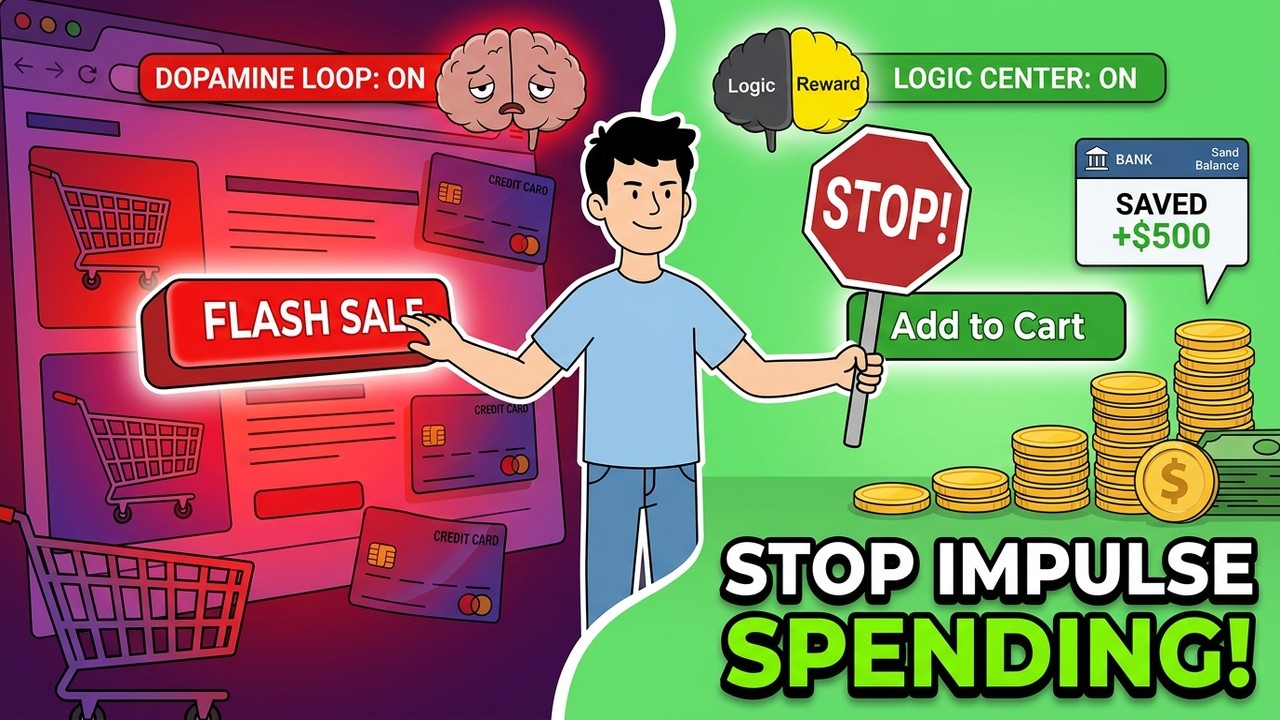
The key insight from the video is the same one this rule is built on: the intensity of wanting something decays over time. The dopamine spike from discovering a desirable item fades within days. What feels urgent today often feels unnecessary in a week. The rule simply gives that decay enough time to work.
What Actually Happens During Those 30 Days
This is the part most explanations skip — the actual lived texture of waiting.
Days 1–3: Peak intensity. The desire is loudest here. You think about the item constantly. You find new reasons it's necessary. You check if it's still in stock. You calculate creative ways it technically fits the budget. This is the impulse operating at full force, and this is the moment almost every bad purchase happens. The emotion is at its highest, and the decision is being made under its maximum influence.
Days 4–7: First softening. The urgency begins to fade. You still want it, but it's no longer occupying every idle thought.
Days 8–14: The gap opens. You may go two or three days without thinking about it at all. When you do, it's quieter.
Days 15–30: Clarity. One of three things has happened: you've forgotten about it entirely (which tells you everything you need to know), you still want it but your reasoning is now clean and calm, or you've found a better alternative or realised you didn't need it at all.
In my experience, roughly 70–80% of items I've added to the list I have never returned to. The desire simply evaporated once I stopped feeding it with attention and urgency.
The 20–30% I do return to? Those are real purchases — things I genuinely wanted after the emotion cleared. I buy those without any guilt, because they survived the test.
The Psychology of Why the 30-Day Rule Works
Most impulse purchases happen at the intersection of two things: emotional arousal and immediate availability.
You feel the desire. The item is available right now. The purchase happens.
The 30-day rule breaks the immediacy. The item is still technically available — you could buy it any time — but the psychological gap between the feeling and the action gives the emotion time to cool.
Decisions made in hot states are systematically worse than decisions made in cool states. You overestimate future enjoyment. You underestimate the actual cost — financial and psychological. You are far more susceptible to rationalisation.
Waiting doesn't make you less happy. It moves you from a hot state to a cool one, where your judgment is more accurate. And the purchases you make from a cool state are almost always the right ones.
What the Pattern Revealed About My Spending
After about six months of keeping a waiting list consistently, something unexpected happened.
I noticed that almost everything I impulsively wanted to buy was tech-adjacent. Hardware. Accessories. Productivity tools. Subscriptions. And the wanting was almost always triggered by a specific category of content — developer YouTube, setup tours, productivity channels.
The desire was not really for the products.
The desire was for the feeling — of being more serious, more capable, more legitimate, more like the developer I wanted to become. The products were just what that feeling had been attached to by the content I was consuming.
Once I saw that pattern in my waiting list, I could see it in real time. That's the moment the developer setup trap stopped being something I read about and became something I could watch happening inside me before I acted on it.
Understanding the emotional source of your spending is the real gift of this rule. The money you save is almost secondary.
How to Actually Set Up the 30-Day Rule (Step by Step)
Keep a dedicated list. Not your general notes app where it will get buried. A specific place. I use a note called "Wants — 30 Day List." Every item: name, rough price, date added. Nothing else needed.
Set a calendar reminder. Do not rely on memory. The day you add an item, set a reminder 30 days out: "Review: [item name]." When it fires, you open the list and decide with a clear head.
Do not browse the item during the wait. Reading reviews, watching unboxings, and checking prices during the waiting period is feeding the desire. You are allowed to want the thing. You are not allowed to give the want more fuel.
Adjust the threshold to your life. My rule: ₹2,000+ gets 30 days. ₹10,000+ gets 45–60 days. Small recurring subscriptions I review monthly. The numbers aren't magic — the waiting is. Pick thresholds that feel slightly uncomfortable and start there.
Tools That Help You Wait Better
Since this post is about building a habit, here are things that have genuinely supported mine — physical and digital. I'm recommending these honestly, not as a list of things to go buy impulsively right now.
A Dedicated Notebook for Your Waiting List
A physical list works differently than a digital one. There's something about the friction of writing by hand — reaching for a pen, opening a notebook, writing the item and the date — that creates a psychological pause that a phone note doesn't.
That pause is part of the mechanism. Use it.
On Amazon India:
- Classmate Soft Cover A5 Notebook — numbered pages and an index make it easy to maintain a running list over months; this is the notebook I'd actually recommend keeping long-term
- Navneet Youva A5 Journal Notebook — compact enough to always have on your desk or in a bag; good if you want something small and always available
- Classmate Pulse A5 Notebook — budget option that does the job; if you want to test the habit before committing to a nicer notebook, start here
A Timer to Build the Pause Habit
The moment you feel an impulse purchase coming, one of the most effective things you can do is physically step away and do something else for 25 minutes before you make any decision. This is the mechanical version of cooling the hot state.
A physical timer that you flip or twist — rather than your phone — keeps you off the screen that probably generated the desire in the first place.
On Amazon India:
- Portronics Timeout Smart Countdown Timer — flip to set your time, no apps, no distractions; genuinely useful for building any timed habit
- Baseus Heyo Rotation Countdown Timer — simple wind-and-go, no batteries needed, does one thing well
Books That Actually Changed How I Think About Money
Most personal finance books give you systems. The best ones give you a different way of seeing. These are the ones I'd recommend to any student or young developer in India who wants to actually change their relationship with spending — not just track it better.
On Amazon India:
-
The Psychology of Money — Morgan Housel — the most important money book I've read, and it's not a how-to at all. It explains why we make bad financial decisions, which is the only way to actually stop making them. The chapter on "reasonable vs rational" directly explains impulse buying better than any finance blog. Read this first.
-
Let's Talk Money — Monika Halan — the best India-specific personal finance book. Written for real Indian lives with real Indian financial products. If you want to understand savings accounts, insurance, mutual funds, and emergency funds in the Indian context — this is it. Not theoretical. Immediately practical.
-
Atomic Habits — James Clear — directly applicable to this post. The 30-day rule is a habit system, and Clear's framework for building and breaking habits is the clearest explanation of why some rules stick and others don't. The chapter on making bad habits difficult to perform is exactly the psychology behind the waiting period.
-
I Will Teach You to Be Rich — Ramit Sethi — written specifically for people in their 20s, irreverent, and deeply practical. US-centric in places but the psychology chapters on guilt-free spending and automating good decisions translate completely.
-
Your Money or Your Life — Vicki Robin — the book that introduced the core idea behind delayed gratification in personal finance. Dense in places, but the central concept — that every purchase costs you hours of your life, not just rupees — permanently changes how you evaluate what something is actually worth.
A Desk Organiser to Keep Your Waiting List Visible
If your notebook is buried in a drawer, you won't use it. Keeping your waiting list notebook visibly on your desk — where you see it every day — is part of the friction that makes the habit stick.
On Amazon India:
- Deli Desktop Organiser with Drawers — keeps notebooks, pens, and documents on the surface without creating clutter
- Solo Mesh Desk Organiser — open design means you can see the notebook at a glance; harder to let it disappear out of sight
How to Build Financial Runway While You're Still Employed
Here is the part most posts like this skip — the boring, practical truth that makes starting your own business possible.
Building your own thing requires a runway. Not a fortune. A runway — enough months of covered expenses that you can take the risk without one bad week destroying everything.
I learned this the hard way. Financial pressure at the wrong moment doesn't just hurt your personal life — it corrupts your decision-making. When you are desperate for revenue, you take the wrong clients. You build the wrong features. You make the deals you would never make if you had three more months of breathing room.
The time to build that runway is now — while you are employed. That means being ruthless about impulse spending, knowing exactly what your minimum monthly costs are, and treating every rupee you save today as a direct investment in your future company's chances.
The invisible tax of starting without generational wealth is real. Understanding it does not mean surrendering to it — it means preparing honestly rather than naively. The people who successfully made the jump from employee to founder almost never did it recklessly. They built their financial floor first, then jumped.
The Honest Part
This rule is not comfortable, at least not at first.
In the moment of wanting something, waiting feels like deprivation. You feel the desire and you're not acting on it, and that feels like loss. There is a version of you in those first three days that will construct very persuasive arguments for why this particular purchase is different, is justified, is actually an investment.
That version of you is not wrong because it's bad. It's wrong because it's operating from incomplete information — from a hot state that will not look the same in 30 days.
Most of the time, by day seven, the "investment" is just a want again. By day thirty, it's often nothing at all.
The rule doesn't deprive you of the things you genuinely want. It separates the things you genuinely want from the things you want right now — which are different categories, even when they feel identical.
Learning to feel that difference, in real time, before you open your wallet: that is the financial skill that everything else is built on.
Frequently Asked Questions
What is the 30-day rule for impulse buying?
The 30-day rule is a personal finance strategy where you delay any non-essential purchase above a set threshold — mine is ₹2,000 — for 30 days before buying. You write the item down with today's date and revisit it after 30 days. If you still want it and can afford it, you buy it guilt-free. If the desire has faded, you've saved money without feeling deprived.
Does the 30-day rule actually work for stopping impulse buying?
Yes — in my experience, roughly 70–80% of items I've added to the list I never returned to. The desire simply evaporated once I stopped feeding it with urgency and attention. The 20–30% I do return to are genuine purchases made with a clear head, not emotional ones. The rule works because it breaks the link between emotional arousal and immediate availability — the two things that drive almost every bad impulse purchase.
How do I start the 30-day rule in India as a student?
Keep a dedicated note on your phone or a physical notebook called "Wants — 30 Day List." Every time you want to buy something non-essential above ₹2,000, write it down with the date instead of buying it immediately. Set a calendar reminder 30 days out. Do not browse the item during the wait. When the reminder fires, decide with a clear head. That's the complete system — no app, no spreadsheet needed.
What is a good threshold amount to use for the 30-day rule in India?
I use ₹2,000 as my base threshold — anything above this gets 30 days. For purchases above ₹10,000, I extend the wait to 45–60 days. The threshold isn't magic — the waiting period is. Choose a number that feels slightly uncomfortable for your current income, and adjust as your finances change. Even a 24-hour rule for small purchases above ₹500 is better than no rule at all.
What should I do during the 30-day waiting period?
Write the item down and set a reminder — then stop actively thinking about it. Specifically: do not browse the product, do not watch unboxings or reviews, and do not check prices. You're allowed to want the thing. You are not allowed to give that want more fuel. The goal is to let the emotional state cool naturally. If you actively feed the desire with content, you're undermining the rule before it has a chance to work.
Related Reading
-
I Spent ₹13,000 of My Scholarship Money on a CPU — Here's What It Taught Me
-
The Developer Setup Trap: Why Better Hardware Won't Make You a Better Developer
Did you find this helpful?
FAQ