- 1A startup will speed up your technical growth faster than almost any other job — but it can also speed up your financial stress if you are not ready for it.
- 2A salary delay of 28+ days does not just drain your wallet. It quietly kills your focus, your confidence, and your decision-making. Your financial health and your work performance are deeply connected.
- 3Building an emergency fund of 3–6 months of expenses before joining a startup is not optional — it is the difference between learning and just surviving.
- 4Your skills are portable; your employer is not. Every line of code you write, every bug you fix, every system you understand — that knowledge belongs to you forever.
- 5Difficulty early in your career is not a sign that you chose the wrong path. It is almost always a sign that you are on the right one — just earlier than the reward.
Startup Salary Delayed 28 Days: My Life at 22 With -₹400 in the Bank
At 22, my bank balance showed -₹400. My startup salary was 28 days late. And every single morning, I still opened VS Code and kept building.
Published: May 27, 2026 · 9 min read · By Veeresh Bashetti
I want to tell you something that most developer blogs will never say out loud.
Not the version where the young engineer struggles for a bit and everything wraps up neatly by the final paragraph. The actual version — the one where you open your banking app at midnight, stare at a number with a minus sign in front of it, and genuinely wonder how you ended up here.
At 22, I was a software developer at a startup.
My bank balance was -₹400.
My salary had been delayed by more than 28 days.
Rent was coming. Bills did not care about my situation. And every single morning — I want you to really hear this — I still opened my laptop, fired up VS Code, and kept building.
This is the story of that chapter. The money pressure nobody warns you about. The technical skills nobody can ever take away from you. And the slow, uncomfortable discovery that a software career is not built during the comfortable months.
Why I Chose a Startup at 22 Instead of a Safe Job
Let me tell you where I was before any of this happened.
I had just finished my MERN stack course at a reputed institute — the kind of place people in India join when they are serious about making a career switch into tech. I completed the MERN track fully. React, Node, MongoDB, Express — I had put real hours into all of it.
Python was still in progress. Not done. Not even close to done.
I gave two interviews anyway.
The first company passed. The second one picked me.
Here is the part that still makes me laugh a little: they did not need my React skills at all. They needed Python. So that is what I shipped with — a stack I was still learning, at a startup I had just joined, at 22, with no safety net and a course I had not finished.
I will write the full story of those two interviews and what that course actually taught me — and what it did not — in a separate post. (Coming soon.)
But that is the context. I did not walk in polished and ready. I walked in mid-learning, with half a skillset, and figured out the rest on the job.
I could have played it safer.
There were bigger companies with more predictable salaries, more clearly defined roles, more stable environments. But I chose this startup because I wanted something very specific — the kind of growth that does not fit neatly into a job description.
I wanted:
- Real ownership over real features, not just tickets in a queue
- The chance to see my code reach actual users within days, not quarters
- Experience across a real stack being used in production, not just coursework
- The speed of decision-making that only small teams have
- The kind of productive discomfort that forces you to grow fast
On the technical side, the startup delivered everything I had hoped for — even if it was in Python instead of the MERN stack I had trained for.
In a short stretch of time — building in Python, a language I was still actively learning on the job — I shipped across the real stack the company needed:
- React applications with complex state management
- Node.js REST APIs connected with third-party services
- MongoDB database design and query optimisation
- JWT-based authentication systems
- CI/CD pipelines and production deployments
- Performance debugging that taught me more than any course ever had
The density of real experience was extraordinary. Problems that a larger company would send to a specialist — I was solving them, learning them, owning them. That kind of fast-tracked learning is genuinely one of the most valuable things a startup can offer a junior developer.
But here is what nobody puts in the job listing: startups trade stability for speed. And sometimes that instability lands directly on your salary.
What a 28-Day Startup Salary Delay Actually Feels Like
People use the phrase "salary delay" casually, like it is a minor inconvenience — a few extra days of waiting you eventually forget about.
Let me tell you what it actually feels like when you are 22 and this is your first real job.
Week one of the delay: Mildly frustrating. You assume it is a processing issue. You check your account a few extra times but you are not panicking yet.
Week two: You start doing calculations you never expected to do. Which subscriptions can I pause? Can I delay this purchase? Is there anything I can sell quickly if I really need to?
Week three: The anxiety is always there now. Running quietly in the background of every single hour. You are sitting in a stand-up meeting and part of your brain is doing math. You are debugging a component and part of your brain is wondering if your landlord will understand. That split attention costs you — both at work and inside.
Past day 28: Something shifts. You stop expecting the salary on any particular date, because resetting that expectation over and over has become too painful. You enter a strange kind of flatness — still doing the work, but emotionally halfway disconnected from it.
Financial stress does not stay in your wallet. It migrates. It slows your thinking. It makes small problems feel bigger than they are. It quietly chips away at the confidence you need to tackle hard technical challenges.
Nobody in the startup world talks honestly about this. The money stress is not just about money — it is about everything the money affects when it simply is not there.
Honest note: If you have ever struggled with impulsive spending to feel better during stressful periods, this is exactly when those habits get expensive. I have written about how the 30-Day Rule helped me stop impulse buying during hard times — it is worth reading before your next difficult month.
The Part That Surprised Me: I Still Loved the Work
Here is something I genuinely did not expect.
Even on the hardest days — when I was calculating whether I could afford both lunch and the commute — I would run into a problem in the code, and something would click, and for a few hours nothing else existed.
The moment an API I had spent two full days debugging finally returned the right response.
The moment a UI component I built from scratch rendered perfectly on every screen size.
The moment a production deployment succeeded and I watched real users interact with something I had made.
These moments did not fix the financial situation. But they reminded me of something important: I had not made a mistake choosing this field. The work itself was worth showing up for.
Programming is a strange profession. You can create something from nothing. A blank file becomes a working application. A vague requirement becomes a real solution that real people use. That creative power does not pause just because your bank balance is negative.
The financial chapter was genuinely difficult. But it did not poison the thing underneath — the craft, the problem-solving, the satisfaction of shipping something real.
4 Things This Year Taught Me That My Course Never Could
1. Your skills are the only asset that cannot be delayed
The institute gave me a foundation. But nobody at the institute told me what to do when the company needed Python and I had trained in MERN. Nobody told me what to do when the salary stopped arriving. Nobody taught me how to keep showing up when the bank balance went negative.
A salary can be delayed. A company can shut down. A role can disappear. But nobody can walk into your head and remove the understanding of how React's reconciliation algorithm works, or why a database index makes your query 40x faster, or how to trace a memory leak through a Node.js process.
Every hard problem I solved during those months became permanent knowledge. That is the trade the startup offered me, and in that specific dimension, it honoured every bit of it.
2. Financial preparation is not optional — it is your first big decision as a developer
I went into that job without an emergency fund. That was my most expensive mistake — more expensive than any gadget or impulsive purchase I had made before.
Three to six months of living expenses, sitting in a separate savings account, changes everything about how you handle uncertainty. It transforms "I cannot afford for this to go wrong" into "I can wait and see what happens." That mental shift is worth far more than the hassle of building the fund.
This connects directly to something I learned later about making rules for yourself before the pressure hits — not during it. Whether it is building an emergency fund or using the 30-Day Rule to stop spending money you do not have, the time to set up the system is before you need it.
If I could give myself one piece of advice before joining any startup, it would be this: build your financial runway before you accept the offer, not after you start.
3. Pressure teaches junior developers faster than comfort ever will
I learned more about debugging real production systems in three months of genuine pressure than I had in six months of side projects. The difference was consequence. When a real user is affected by a real bug, your attention has a quality it simply does not have when the stakes are personal and low.
That kind of focused, consequence-driven learning is hard to replicate. It is uncomfortable in the moment, but the kind of developer it produces is one who can perform when it actually matters.
4. A negative bank balance is not a career signal — it is a timing signal
This is the trap that catches so many young developers in their first difficult chapter. They look at their financial situation and read it as evidence that they made the wrong choices — wrong company, wrong field, wrong career path.
It is not evidence of that. It is evidence of being early.
Every developer you respect who is now comfortable has some version of this story. The timing changes. The currency changes. The specific startup changes. But the chapter of financial uncertainty mixed with fast skill-building while wondering if you made the right call — that chapter is nearly universal.
Your bank balance is a lagging indicator. The skills you are building right now are a leading one.
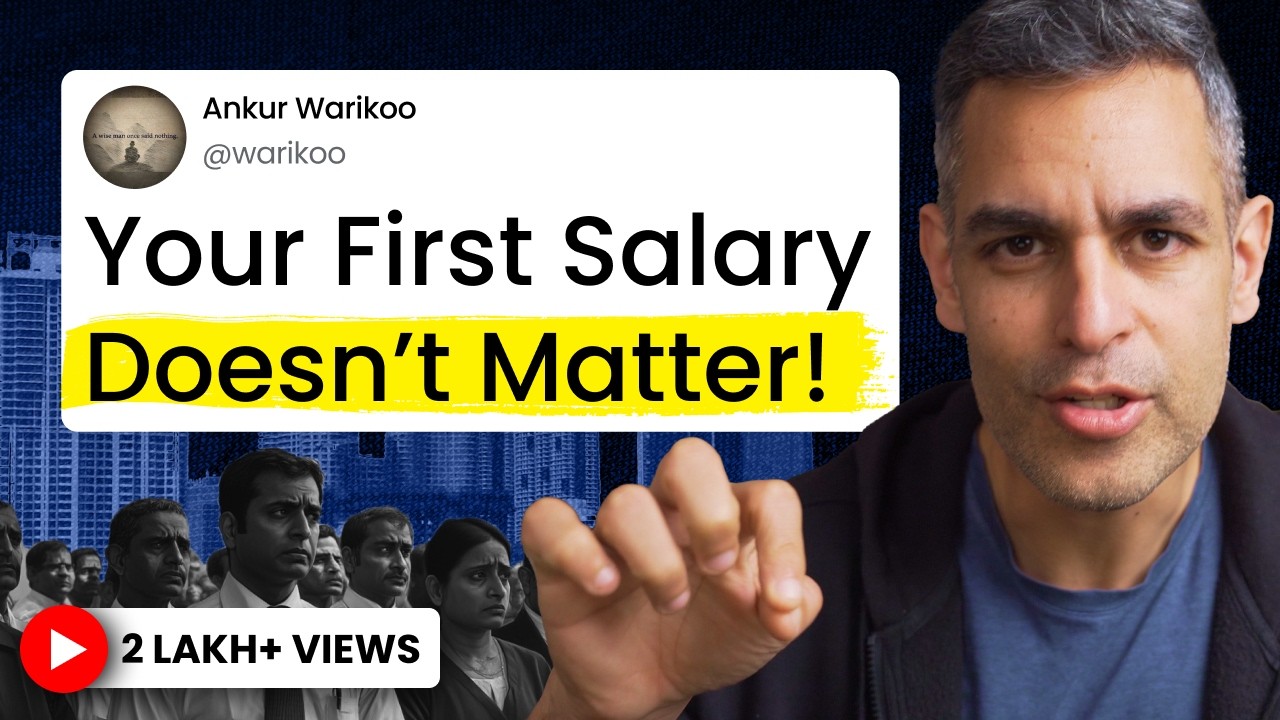
If this section landed for you, Warikoo's take on exactly this — why chasing your first salary is the wrong focus and what actually matters in your early career — is worth 10 minutes of your time:
The Money Habits I Wish I Had Before Joining a Startup
I did not have a system before this. I was spending impulsively, not tracking anything, and not building any buffer.
Here is what I have since learned — the hard way:
Build your emergency fund before you need it. Not after the delay starts. Before. Three months of your fixed expenses in a separate account that you do not touch. This one habit would have completely changed how I experienced those 28 days.
Know your exact monthly minimum. Add up rent, food, transport, and any EMIs. That number — the lowest amount you can genuinely survive on — gives you clarity and control. Once you know it, financial stress loses some of its power over you.
Pause impulse spending before it starts. When you are under money pressure, the temptation to spend your way out of a bad feeling is real. I have been there — buying small things to feel better, making purchases I had not planned because the discomfort demanded relief. The 30-Day Rule is the single habit that has done the most to stop this cycle for me. Write it down, wait 30 days, and let the emotion clear before deciding.
Talk honestly to other developers. The version of startup life you see on LinkedIn is a highlight reel. Real conversations with developers who are being honest about their experience are worth more than ten inspirational posts.
The Morning Routine That Kept Me From Falling Apart
Every morning during the hardest weeks, I followed the same sequence.
I did not open the banking app first.
I made tea. I opened VS Code. I picked up exactly where I had left off the evening before. And I worked for ninety minutes before I did anything else.
The work grounded me. It reminded me that regardless of what that number in the app said, I was becoming a better developer than I had been the day before. That progress was real. It was mine. And it was happening regardless of whether the salary had landed yet.
Eventually, the salary came. The financial pressure lifted. The chapter closed.
But the habit — starting with the work, not the worry — that stayed.
What I Would Tell Any 22-Year-Old Indian Developer Right Now
If you are in a similar situation — startup, delayed salary, doubt, -₹400 or worse — here is what I actually believe, not what I say to sound optimistic:
Keep shipping. The portfolio you build during difficult periods carries more weight than one built when everything is comfortable, because you built it anyway. That matters.
Build the emergency fund before you need it. Three months of expenses. Separate account. Do not touch it for anything except a genuine emergency. Build it before joining any startup.
Know your monthly minimum. Not what you want to spend — what you truly need to survive. That number gives you power.
Stop impulse spending when you are stressed. It feels like relief in the moment and regret within a week. A simple waiting rule can save you from making expensive decisions during your most vulnerable months.
Do not confuse financial struggle with career failure. They are measuring different things on completely different timescales. A month of money difficulty says nothing at all about a decade of career growth.
Close the Banking App. Open the Editor.
Today your balance might still be in difficult territory.
The future might still feel uncertain.
The startup might still be testing your patience.
But here is what I know for certain: the code you write today is more capable than the code you wrote six months ago. The problems you can solve now are harder than the ones you could solve when you started. The developer you are becoming is worth more than the developer you were.
That direction of travel is what matters.
Close the banking app.
Open the editor.
Keep shipping.
Because that is the only thing that moves both numbers — the one in your account and the one in your career — in the direction they need to go.
Frequently Asked Questions
Is it normal for startups to delay salaries in India?
Unfortunately, yes — salary delays are common in early-stage startups in India, especially seed-funded or bootstrapped companies with unpredictable revenue. Delays of 15 to 45 days are not unusual. Before joining a startup, research the company's funding stage, runway, and check employee reviews on platforms like Glassdoor and Ambitionbox. A signed offer letter that mentions salary dates and a penalty clause for delays gives you some protection.
How should a young developer financially prepare for startup life in India?
Before joining a startup, build a 3–6 month emergency fund. Keep your fixed monthly expenses (rent, food, transport, EMIs) as low as possible. Avoid taking on debt for lifestyle upgrades. Use the first 60 days of any job to build savings before spending on anything extra. Never treat your first salary as proof that steady cash flow is guaranteed.
What skills should a 22-year-old developer focus on at a startup?
Focus on understanding the full stack early — learn React or Vue on the frontend, Node.js or Python on the backend, and basic database design (PostgreSQL, MongoDB). Beyond technical skills, product thinking (understanding why you are building something) and debugging under production pressure are the two skills that separate junior developers from mid-level ones the fastest.
How do you stay motivated as a developer during financial difficulty?
Keep your professional identity separate from your bank balance — they are measuring completely different things. Create small, daily wins: fix a bug, ship a feature, learn one new concept. Maintain a private document where you log what you have built and learned each week. When motivation drops, reading that log is a powerful reminder of how far you have come.
Should I quit a startup if my salary is delayed?
It depends on the pattern and the communication. A one-time delay with honest communication and a clear payment date is very different from a repeating delay with evasive management. If salary delays happen more than twice in a six-month period without a believable explanation, that is a serious red flag. Protect your financial wellbeing first — no amount of learning justifies working without being paid on time, consistently.
Keep Reading
- Working in a Startup But Dreaming of Building My Own — The Developer's Dilemma — if the salary delay made you wonder whether you should just build your own thing instead
- The 30-Day Rule: The Only Spending Habit That Actually Changed My Financial Life — the system I wish I had before the salary delay started
- Why Suffering Without Generational Wealth Hits Different — the honest financial reality of starting from zero as an Indian developer
- The Childhood Mistake That Changed My Life Forever — on the small decisions that quietly shape the person you become
- The Full Story: MERN Course, Two Interviews, and How I Ended Up Writing Python (coming soon) — the complete journey from joining a reputed course institute to landing my first job in a stack I had not finished learning
If this resonated with you, share it with a developer who is early in their career and needs to hear that a difficult chapter is not the end of the story — it is almost always the beginning of the better part of it.
Did you find this helpful?