- 1A salary is not evil. It becomes a trap only when it replaces every other source of safety, identity and self-worth a person has.
- 2The loop of relief-then-anxiety every month is not weakness — it's a predictable psychological pattern, and naming it correctly is the first real step out of it.
- 3People who leave the loop and seem happier were not fearless. They simply stopped waiting for fear to disappear before they moved.
- 4Comfort and growth rarely live in the same room. Choosing comfort every single month, for years, is still a choice — just a quiet one.
- 5You do not need to quit your job to break the loop. You need one thing outside your salary that is entirely yours.
- 6Clarity, once it actually arrives, doesn't feel dramatic. It feels quiet — like finally putting down something heavy you'd been carrying so long you forgot it had weight.
- 7The fear underneath the loop is rarely about the number in your account. It's about who you'd be without the job title attached to your name.
Salary Is a Drug: Why the Paycheck That Saves You Is Also the One Trapping You
For two or three days after salary hits your account, everything feels fine. Then, quietly, the same old anxiety creeps back in — and you start counting down to the next date all over again.
Published: July 3, 2026 · 16 min read · By Veeresh Bashetti
I want to say something out loud that most people only ever say to themselves at 1 a.m., scrolling their bank app for the fourth time even though the balance hasn't changed since the last time they checked it two minutes ago.
Salary is a drug.
Not a metaphor I'm using for effect. I mean it almost literally — the same predictable loop, the same short relief, the same comedown a few days later, the same craving for the next hit. I've lived inside that loop for years, first as a 21-year-old fresh out of college working a sales job I didn't particularly enjoy, and later even after I moved into development work I actually cared about. I still catch myself in it some months, even now, even after knowing exactly what it is and exactly how it works. Knowing the mechanism doesn't automatically switch it off. That's the uncomfortable part nobody tells you.
And here's the part that made me actually sit down and write this: a lot of people around me are doing the exact same thing — living for that one date every month — and some of them genuinely seem happier than me doing it. Not because they've escaped the loop. Because they've made peace with staying inside it. Meanwhile, I keep circling the same question, month after month, without ever fully answering it.
So I'm writing this not as advice from someone who's "figured it out" and is now selling you a course about it. I'm writing this as someone still standing inside the loop, trying to describe it clearly enough that maybe — for both of us — the mind clears a little, just once, properly.
Table of Contents
- The Loop Nobody Talks About
- Why the Drug Comparison Actually Fits
- My Own Month, Broken Down Honestly
- "But Some People Seem Happier Doing This"
- Golden Handcuffs: When the Trap Gets Comfortable
- The Question Underneath the Question
- What Actually Breaks the Loop
- What Didn't Work For Me
- Clearing the Mind, Once
- Frequently Asked Questions
The Loop Nobody Talks About
Here's what the loop actually looks like, stripped of all the polite language we usually wrap around it.
Salary day arrives. For a day, maybe two, there's relief. Bills get paid. EMIs get cleared. Rent goes out. Maybe something small gets bought — nothing big, just something that says I earned this, I deserve this. For a short window, the fear that had been quietly sitting in the background for the last few weeks goes silent.
Then, almost on schedule, it comes back. The account balance starts shrinking again. The mental math starts again — how many days left, what's due next, what can wait. And somewhere around the middle of the month, the same low hum of anxiety returns, right on time, like it never actually left. It was just waiting for the relief to wear off.
That is not a coincidence. That is not "just how adult life is." That is a loop — reward, relief, comedown, craving, repeat — and it is structurally identical to how any mild dependency works. The object of dependency is not a substance. It's a date on the calendar.
I'm not saying this to be dramatic. I'm saying it because naming a loop correctly is usually the first real step toward understanding why it has so much power over you. You cannot loosen the grip of something you refuse to look at directly.
Why the Drug Comparison Actually Fits
A drug doesn't trap someone because it's evil. It traps someone because, in the short term, it genuinely works. It relieves something real — pain, fear, exhaustion — faster and more reliably than almost anything else available in that moment.
Salary works exactly the same way.
It relieves something real. Rent. Food. A parent's medical bill. A sibling's school fee. The fear of not being able to provide is one of the most primal fears a person can carry, and salary is the fastest, most reliable thing most of us have ever found to make that fear go quiet, even briefly.
The problem is not that salary relieves fear. The problem is what happens after years of relying on the same relief, on the same schedule, without ever addressing what's underneath the fear itself. The relief becomes the whole strategy. Nothing else gets built — no separate skill, no separate income, no separate identity outside the job title on the ID card. So the day the salary is delayed, reduced, or removed, the fear doesn't just return. It returns amplified, because for years there was nothing else standing next to it.
That's the trap. Not the salary itself. The complete absence of anything else in the room with it.
There's also a quieter mechanism at play, one I didn't notice until I actually sat down and mapped my own months out on paper: the loop rewards you for not thinking about it too hard. Every month it works, it reinforces the belief that thinking about alternatives is unnecessary, even risky. The system doesn't need to be evil to keep you inside it. It just needs to keep working just well enough, just often enough, that questioning it feels like more effort than it's worth.
My Own Month, Broken Down Honestly
I sat down once, mostly out of frustration, and actually wrote out what a typical month looked like for me emotionally, not just financially. It was uncomfortable to see in writing, but it made the loop impossible to deny.
Days 1–3: Relief. Rent paid, a few pending bills cleared, maybe a small treat — a better coffee than usual, an item I'd been putting off buying. A genuine, if short-lived, sense of "I'm okay."
Days 4–12: Neutral. Work happens. Life happens. The salary fades into the background, mostly unnoticed, the way you stop noticing a hum once you've heard it long enough.
Days 13–20: The math starts, quietly at first. A subscription renews. A card statement arrives. I start doing the small mental subtraction I always tell myself I won't do this month — and I always do it anyway.
Days 21–27: The low hum turns into something closer to a knot. Not panic, nothing dramatic, just a persistent background tension that shows up in small ways — checking the balance more often, being slightly shorter with people, sleeping a little worse.
Days 28–30: Counting down. Genuinely counting down, the way you'd count down to a flight, except the "trip" is just... the same cycle starting over.
Writing that out was the first time I actually believed my own thesis instead of just intellectually agreeing with it. It wasn't a bad month I was describing. It was every month, with only the intensity changing.
"But Some People Seem Happier Doing This"
This is the part that used to genuinely confuse me, and honestly, it still does some days.
I know people who have been in the exact same job, the exact same loop, for ten, fifteen years — and they seem fine. Not just fine. Content. They plan their month around the same date, they've made peace with the same rhythm, and they don't seem to be quietly suffering the way I sometimes catch myself doing.
I used to think that meant something was wrong with me — that everyone else had figured out contentment and I hadn't. But the more honestly I looked at it, the more I noticed something else. It's not that they escaped the loop. It's that they stopped fighting it. They made a real, conscious decision somewhere along the way that stability was worth more to them than the uncertainty of trying something else, and they stopped treating that decision as a compromise. For them, it isn't a cage. It's a choice they made peace with.
The people who leave and seem happier on the other side made a different, equally real decision — that uncertainty, for a while, was worth more to them than the comfort of the loop. Neither group is wrong. What actually causes suffering isn't the loop itself. It's being stuck between the two decisions, refusing to consciously choose either one, and quietly resenting whichever life you're currently living because you never actually decided to live it — you just kept renewing it by default, one month at a time.
I think this is the single most misunderstood part of the entire salary conversation. People assume the goal is to escape the loop entirely. It isn't. The goal is to be inside it on purpose, or outside it on purpose — not inside it by accident, which is where most of the quiet resentment I see in people (and in myself) actually comes from.
Golden Handcuffs: When the Trap Gets Comfortable
There's a term for a specific, more advanced version of this loop: golden handcuffs. It describes what happens when the compensation, the perks, or the sheer comfort of a role become good enough that leaving starts to feel almost irrational — even when the actual work has stopped fitting who you are.
I've watched this happen to people close to me. The job stops being exciting years before they admit it out loud. The learning curve flattens. The sense of purpose thins out. But the salary keeps climbing, the designation keeps sounding more impressive at family functions, and the math of "what would I even switch to" keeps getting harder to justify walking away from. So they stay. Not because they're happy. Because the exit cost, measured purely in money, keeps rising faster than their willingness to pay it.
Golden handcuffs are a more polished version of the same salary loop — just with better lighting. The relief is bigger, so the anxiety underneath is easier to ignore for longer. But it's the same structure: a number that quiets fear temporarily, standing in for something the person hasn't built yet, which is an identity and a set of options that don't depend on any single employer's decision.
I don't think the answer is to be suspicious of a good salary. I think the answer is to notice when a good salary has quietly become the only reason you're still there.
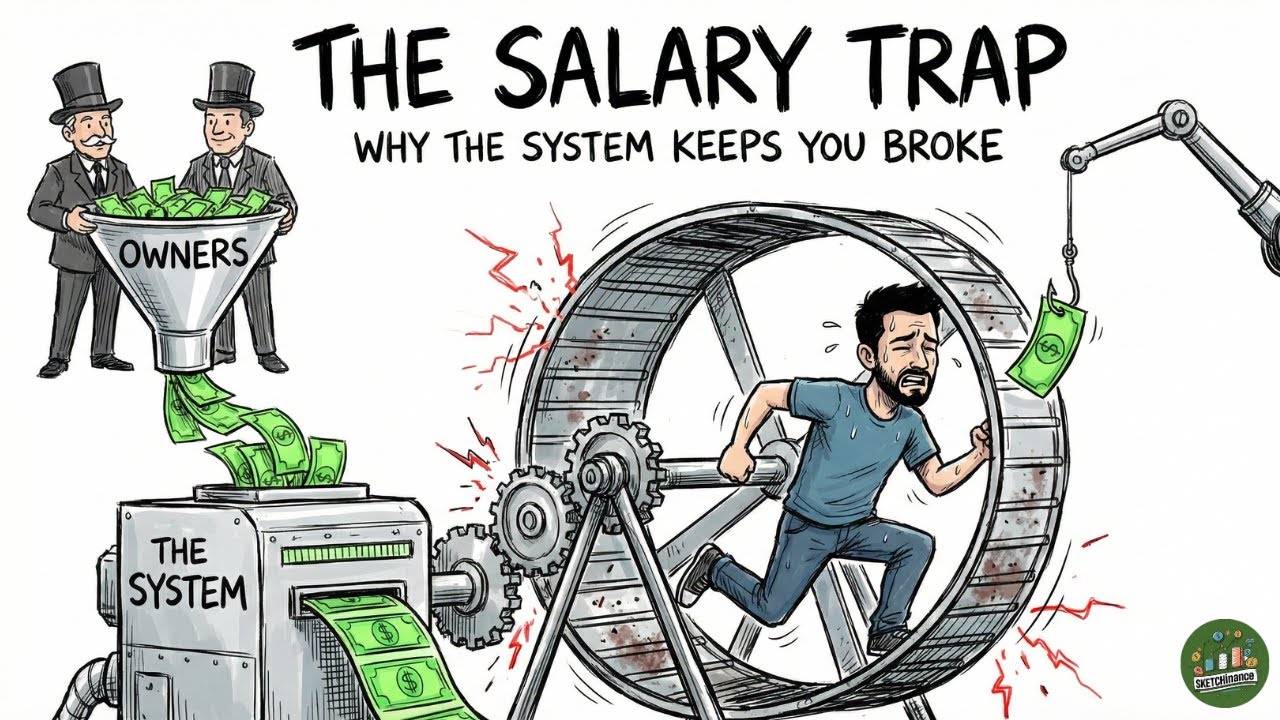
If you want this exact loop mapped out story-by-story rather than just described, this video walks through the same pattern — the illusion of stability, lifestyle inflation, and the golden handcuffs moment — through one person's month:
The Question Underneath the Question
If I'm being fully honest with myself, the real question was never "should I stay in this job or leave it." That question is easy to ask because it feels productive, even when nothing changes.
The real question is quieter and harder: what am I actually afraid of, underneath the money?
For most of us, it's rarely the number itself. It's what the number represents. Being seen as someone who couldn't provide. Disappointing people who are counting on us. Losing the one identity we've built our entire adult life around — "the person with the stable job" — and not knowing who we are without it.
Salary doesn't just pay bills. It quietly pays for an identity too. And that's exactly why leaving the loop feels so much scarier than a simple spreadsheet of income versus expenses would suggest. You're not just risking money. You're risking the story you've been telling yourself and everyone else about who you are.
Once I actually admitted that to myself — that the fear was about identity, not just income — the loop started to loosen its grip a little. Not disappear. Loosen. That's an important difference, and I think conflating the two is where a lot of well-meaning advice on this topic goes wrong. Nobody "solves" this in one weekend of journaling. It loosens, slowly, the more honestly you keep looking at it.
What Actually Breaks the Loop
I'm not going to tell you to quit your job. That would be dishonest, because I haven't done that myself, and I'm deeply suspicious of advice from people who haven't actually lived what they're recommending.
What I can say, from actually sitting inside this loop for years, is what seems to loosen it — even a little, even without doing anything dramatic.
Build one thing that doesn't depend on the salary date. A skill you're improving on your own time. A small side income, even a tiny one. Savings that exist specifically so they're never touched, so they quietly become proof to yourself that you're not entirely dependent on one number arriving on one date. It doesn't need to replace the salary. It just needs to exist, so the loop isn't the only thing standing between you and fear.
Separate your identity from your job title, on purpose, before you're forced to. Most people only do this after a layoff, a resignation, or a health scare — when it's forced on them, in the worst possible circumstances. Doing it earlier, deliberately, while nothing is actually wrong, costs nothing and changes everything about how tightly the loop can hold you.
Actually choose, instead of defaulting. Sit down, honestly, and decide: am I staying because this is genuinely what I want, or because leaving is simply too frightening to look at directly? Both are valid reasons to stay. Only one of them will keep quietly resenting you if you don't admit it out loud.
Track the loop for one month, in writing. I mentioned this earlier because it's the single most useful exercise I've done around this. You don't need a system or an app. A notes file with three lines a day — what you did, how you felt about money that day, one honest sentence about why — is enough to turn a vague feeling into a visible pattern. Patterns are much easier to change than feelings.
Talk about it out loud with one person who won't try to fix it immediately. Most conversations about money jump straight to advice — invest here, save that percentage, read this book. What actually helped me was one conversation where the other person just let me describe the loop without offering a single solution. Being heard clearly did more than any spreadsheet.
None of this removes the loop entirely. I don't think it fully goes away for most of us. But it stops being the only thing in the room, and that alone changes how heavy it feels.
What Didn't Work For Me
In the interest of being genuinely useful and not just inspirational, here's what I tried that didn't actually loosen the loop, even though it's the advice you'll see most often.
"Just budget better." I did. I built spreadsheets. The anxiety didn't come from bad math — my math was usually fine. It came from having exactly one source of income and no buffer of identity outside it. Budgeting made the number more precise. It didn't make the fear smaller.
"Just save more aggressively." This helped, but slower and less than I expected, because savings sitting untouched didn't feel like freedom until I actually tested that freedom — which meant they had to grow large enough to survive a real gap, not just look reassuring on a screen. A small emergency fund reduced panic. It didn't reduce the monthly loop.
"Just find a job you love more." I did, in fact, move from sales into development work I genuinely care about. The loop didn't disappear. It just got quieter for a while, then came back in a slightly different shape, because the loop was never really about which job. It was about having only one lever to pull for safety, regardless of what that lever was attached to.
I'm including this section because I think a lot of writing on this topic quietly implies that the right combination of tips will make the feeling go away completely. In my experience, that's not honest. The feeling gets smaller and more manageable. It doesn't vanish.
Clearing the Mind, Once
Here's the honest ending, without a neat bow tied around it.
I don't think the answer is "quit your job" or "stay forever and be grateful." I think the answer is smaller and less satisfying than either of those, which is probably why nobody says it out loud very often.
The answer is: notice the loop. Name it correctly, the way I've tried to here. Ask yourself, honestly, what you're actually afraid of underneath the money. Build one small thing that isn't dependent on the same date every month. And then, actually choose — consciously, out loud if you have to — instead of quietly defaulting into the same decision for another year without ever deciding anything at all.
That's it. That's the whole clearing of the mind. It's not dramatic. It doesn't feel like an epiphany. It feels more like finally putting down something heavy that you'd been carrying for so long, you'd forgotten it even had weight.
If you're in the loop right now, reading this at the same hour I've written most of it — you're not weak, and you're not behind everyone else who "figured it out." You're just carrying something very common, very human, and very rarely named correctly. Naming it is not the whole solution. But it's the first honest step out of the loop, and most people never even take that.
Frequently Asked Questions
Why does salary feel like an addiction?
Salary works on the same psychological loop as any mild addiction — a predictable reward, temporary relief from fear, and a comedown a few days later when the relief fades and the same anxiety returns.
Is it bad to want a stable salary?
No. Wanting stability is not the problem. The problem is when a salary becomes the only source of identity, safety and self-worth a person has, so much so that they stop building anything outside of it.
Why do some people leave stable jobs and seem happier?
They usually aren't fearless. They stopped organizing their entire identity around one monthly number and started building something that was actually theirs, even if it paid less at first.
How do you break the salary loop without being reckless?
You don't have to quit your job. The loop breaks the moment you build something outside your salary that doesn't depend on it — a skill, a small side income, real savings, or simply clarity about what you actually want.
What is the real difference between salary and freedom?
Salary buys comfort today. Freedom buys options tomorrow. Confusing the two is where most people get stuck.
What are "golden handcuffs" and how are they different from just having a job?
Golden handcuffs describe a role so well-compensated that leaving feels irrational, even once the work has stopped fitting who you are. It's the same salary loop, just with more comfort covering the same underlying fear.
How do I know if I'm actually stuck, or just going through a rough month?
A rough month passes once its cause is gone. Being stuck in the loop feels the same in good months and bad ones — the dread returns every cycle regardless of how the actual work is going.
Does this apply even if I actually like my job?
Yes. Liking your work and being unhealthily dependent on it for your entire sense of safety are two separate things, and they can absolutely coexist.
About This Post
I write everything on this blog from direct, personal experience, not research summaries or borrowed opinions. This post comes from actually living inside this loop for years — first in a sales role I took mostly out of necessity, later in development work I chose on purpose — noticing the same pattern month after month regardless of which job I was in, and finally sitting down to describe it honestly instead of pretending I'd already solved it. Nothing here is theoretical advice I read somewhere and repackaged; it's a pattern I tracked in my own life, in writing, before I trusted myself to write about it publicly. If you're in this loop too, or you've already found your way out of it, I'd genuinely like to hear how.
Keep Reading
- I'm Building Someone Else's Dream — But My Mind is Already Designing My Own Kingdom — what it feels like to sit inside this exact loop while quietly building something of your own on the side
- Why Suffering Without Generational Wealth Hits Different — on why the fear underneath the salary loop is rarely just about money
- 7 Money Mistakes I Made in My 20s (That Nobody Warned Me About) — the practical side of loosening the loop, one habit at a time
- Budgeting for Beginners in India: The 3-Bucket Method That Actually Works — a simple system for building the "something outside the salary date" this post talks about
- Doraemon, Chhota Bheem, Shinchan, Oggy: The Cartoons That Quietly Taught Me How to Think — on the quiet lessons we absorbed long before salary, fear or comfort ever entered the picture
If this named something you've been feeling but never quite put into words, share it with someone else stuck in the same loop. Some things are easier to see clearly once someone else says them out loud first.
Did you find this helpful?